Peptide Blog Article
What Should Beginners Know Before Dosing Peptides? | Beginner's Guide
Starting with peptides can feel overwhelming, especially when you're faced with unfamiliar terms like milligrams (mg), micrograms (mcg), syringe units, and reconstitution. Understanding these fundamentals before preparing your first dose can help you avoid common calculation mistakes and better understand the process. This beginner-friendly guide explains the essential concepts every newcomer should know, including unit conversions, peptide reconstitution, proper storage after mixing, and the importance of using accurate calculations instead of mental math. It also covers the basic supplies commonly used during reconstitution, a simple first-time checklist, and several common mistakes that beginners often encounter. Whether you're learning how peptide concentrations work or simply want to understand the terminology, this guide provides a solid educational foundation before moving on to more advanced topics. You can also use the free tools available at PeptideCalculator.uk to calculate reconstitution volumes, convert doses, estimate syringe units, and simplify peptide-related calculations with confidence. This guide is intended for general educational purposes only and does not provide medical advice. Always consult a qualified healthcare professional regarding medical questions.
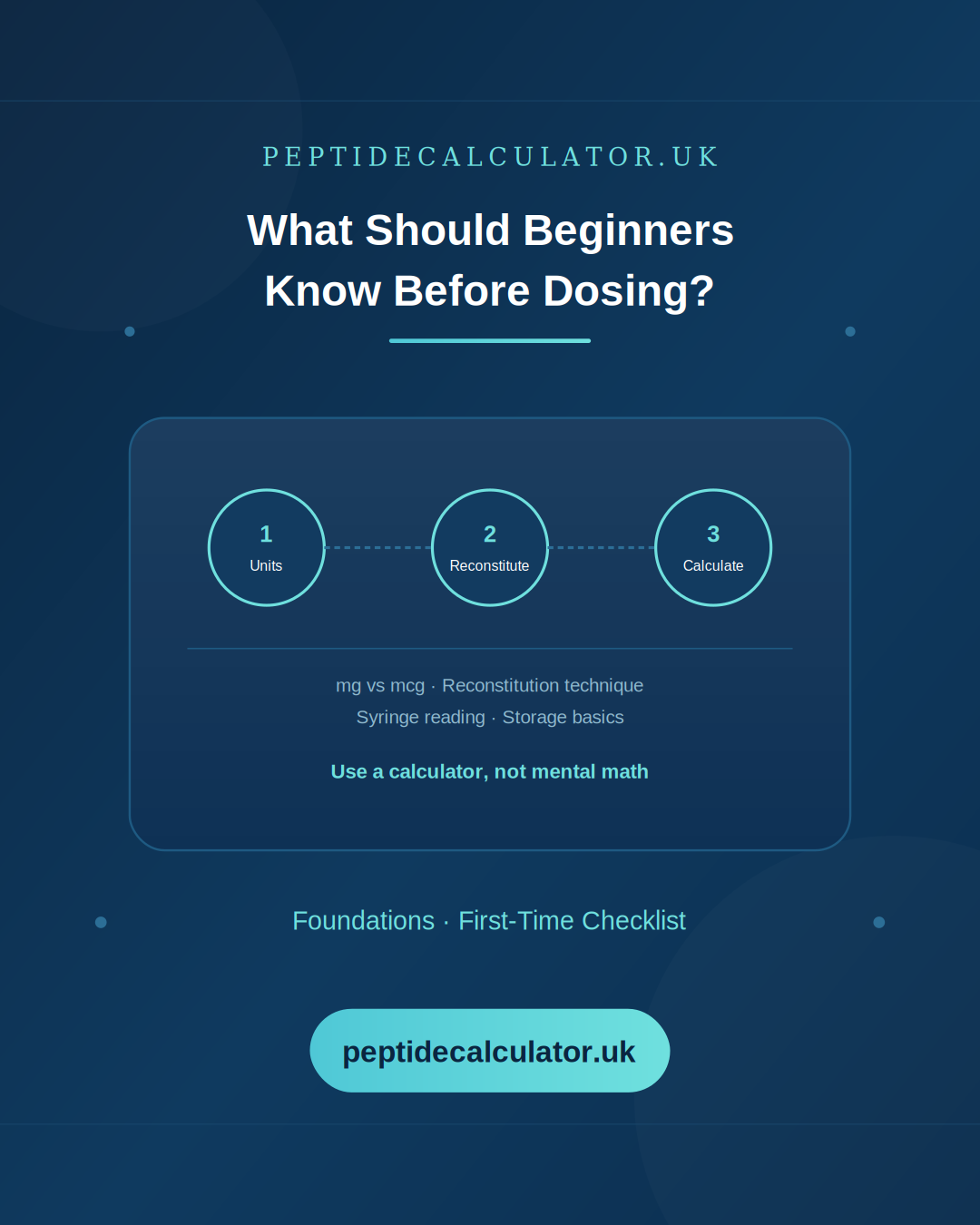
What Should Beginners Know Before Dosing Peptides?
Getting started with peptides involves more moving parts than it might first appear — unit conversions, reconstitution technique, syringe reading, and storage all need to come together correctly before a single dose is drawn. This guide walks through the foundational concepts every beginner should understand first, with links to more detailed guides on each specific piece.
This article is for general education only. It is not medical advice. Consult a licensed healthcare provider before using any peptide.
Start With the Units
Peptide dosing involves three different units that don't automatically translate into each other in your head: milligrams (mg), micrograms (mcg), and syringe units. Vials are typically labeled in mg, doses are typically discussed in mcg, and syringes are marked in units — mixing any of these up is the most common source of a significant dosing error for beginners specifically.
1 mg = 1,000 mcg
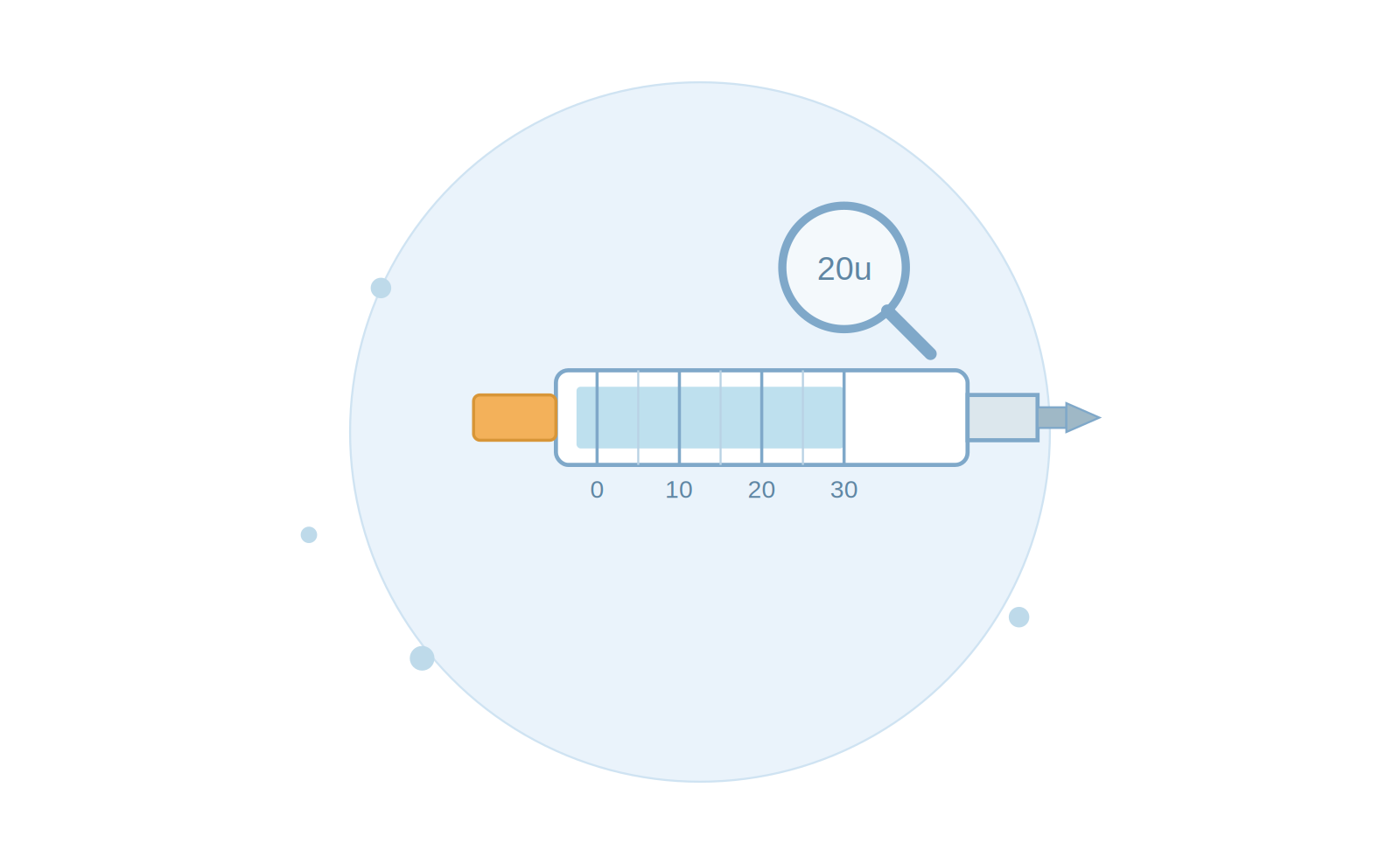
100 units = 1 mL (on a standard U-100 syringe)
Our mg to mcg conversion guide and units-to-syringe guide each cover one of these conversions in depth — it's worth reading both before your first reconstitution.
Understand Reconstitution Before You Start
Reconstitution is the process of mixing a lyophilized (freeze-dried) peptide powder with a diluent, usually bacteriostatic water, to create an injectable solution. The amount of water you use directly determines your solution's concentration, which in turn determines how many syringe units correspond to your target dose. Our full reconstitution guide walks through this process step by step, including proper technique for adding water and avoiding excess foaming.
Use a Calculator, Not Mental Math
Manually converting between mg, mcg, water volume, and syringe units — especially for a first-time reconstitution — is exactly where beginners most commonly make mistakes. Using a dedicated peptide calculator removes this risk by handling the full formula automatically once you enter your vial strength, water volume, and target dose.
Units to draw = (Target dose in mcg ÷ (Vial mg × 1000)) × Water added (mL) × 100Know What "Storage" Actually Means for a Reconstituted Vial
Once mixed, a peptide's shelf life drops significantly compared to the dry powder — often to a window of days to a few weeks, depending on the specific compound. Beginners sometimes assume the same long-term storage rules apply after reconstitution, which isn't the case. See our storage guide for what affects this window and the signs a vial should no longer be used.
Basic Supplies You'll Need
- The peptide vial itself (lyophilized powder)
- Bacteriostatic water (or the specific diluent recommended for your product)
- Alcohol swabs for sanitizing vial tops
- A syringe appropriate for your dosing (commonly a U-100 insulin syringe for small-volume peptide doses)
- A way to label your vial (date and calculated concentration)
A Simple First-Time Checklist
- Confirm your vial's exact labeled strength — don't assume based on a similar product you've seen before.
- Decide on a water volume that produces a convenient, easy-to-read syringe unit count for your target dose. Test this in a peptide dosage calculator before mixing.
- Reconstitute using proper technique — room temperature ingredients, slow injection along the vial wall, gentle swirling rather than shaking.
- Label the vial immediately with the date and concentration.
- Calculate your first dose's syringe draw using the calculator, double-checking your inputs.
- Store the vial correctly — refrigerated, protected from light, used within its specified stability window.
Common Beginner Mistakes
- Confusing mg and mcg, leading to a syringe draw that's off by a factor of 1,000.
- Assuming syringe units equal milliliters. They don't — see the conversion guide above.
- Shaking the vial instead of swirling it gently during reconstitution, which can affect the peptide's structure.
- Not labeling the vial, leading to uncertainty about concentration and reconstitution date later.
- Estimating a syringe draw instead of calculating it precisely, especially for a first-time dose.
- Assuming dry-powder storage rules apply after reconstitution.
Frequently Asked Questions
What's the single most important thing to get right as a beginner? Correctly distinguishing between mg and mcg when reading your vial's strength and your target dose — this is the most common source of significant dosing errors, and it's avoidable by double-checking units explicitly every time.
Do I need any special equipment beyond a syringe and bacteriostatic water? The basic supplies list above covers what's needed for standard reconstitution. Some people also find alcohol swabs and a dedicated small refrigerator space helpful for consistent storage.
Is it normal to feel unsure the first few times? Taking extra time to double-check your calculations and technique when starting out is a reasonable approach — using a calculator rather than relying on memory or mental math is one of the most effective ways to reduce first-time errors.
Where should I go if I have questions specific to a particular peptide? Our compound-specific guides (covering peptides like BPC-157, semaglutide, and others) each walk through that compound's own formula and considerations in more depth — start with our full article library to find the one relevant to what you're using.
Final Thoughts
The foundation of confident peptide dosing is understanding the three core units (mg, mcg, syringe units), following correct reconstitution technique, and using a reliable peptide calculator rather than manual math for every dose. Taking the time to get comfortable with these basics before your first injection makes the entire process far less error-prone going forward.
This article is for general education only. It is not medical advice. Consult a licensed healthcare provider before using any peptide.