Peptide Blog Article
Mg to mcg Peptide Converter: How to Get It Right Every Time
A misplaced decimal between milligrams and micrograms is the most common — and most serious — mistake in peptide dosing. This guide breaks down the mg-to-mcg conversion clearly, with a quick reference chart, a worked formula, and how to protect yourself from a 1,000x dosing error.
Mg to mcg Peptide Converter: How to Get It Right Every Time
A misplaced decimal between milligrams and micrograms is the single most common — and most serious — mistake in peptide dosing. The difference between 1mg and 1mcg is a factor of 1,000, and vials, doses, and syringes don't always use the same unit, which is exactly where confusion creeps in.
This guide breaks down the mg-to-mcg relationship clearly, shows you how to convert correctly, and explains why this specific conversion deserves more caution than almost anything else in a reconstitution protocol.
This article is for general education only. It is not medical advice. Always consult a licensed healthcare provider before using any peptide.
The Core Conversion
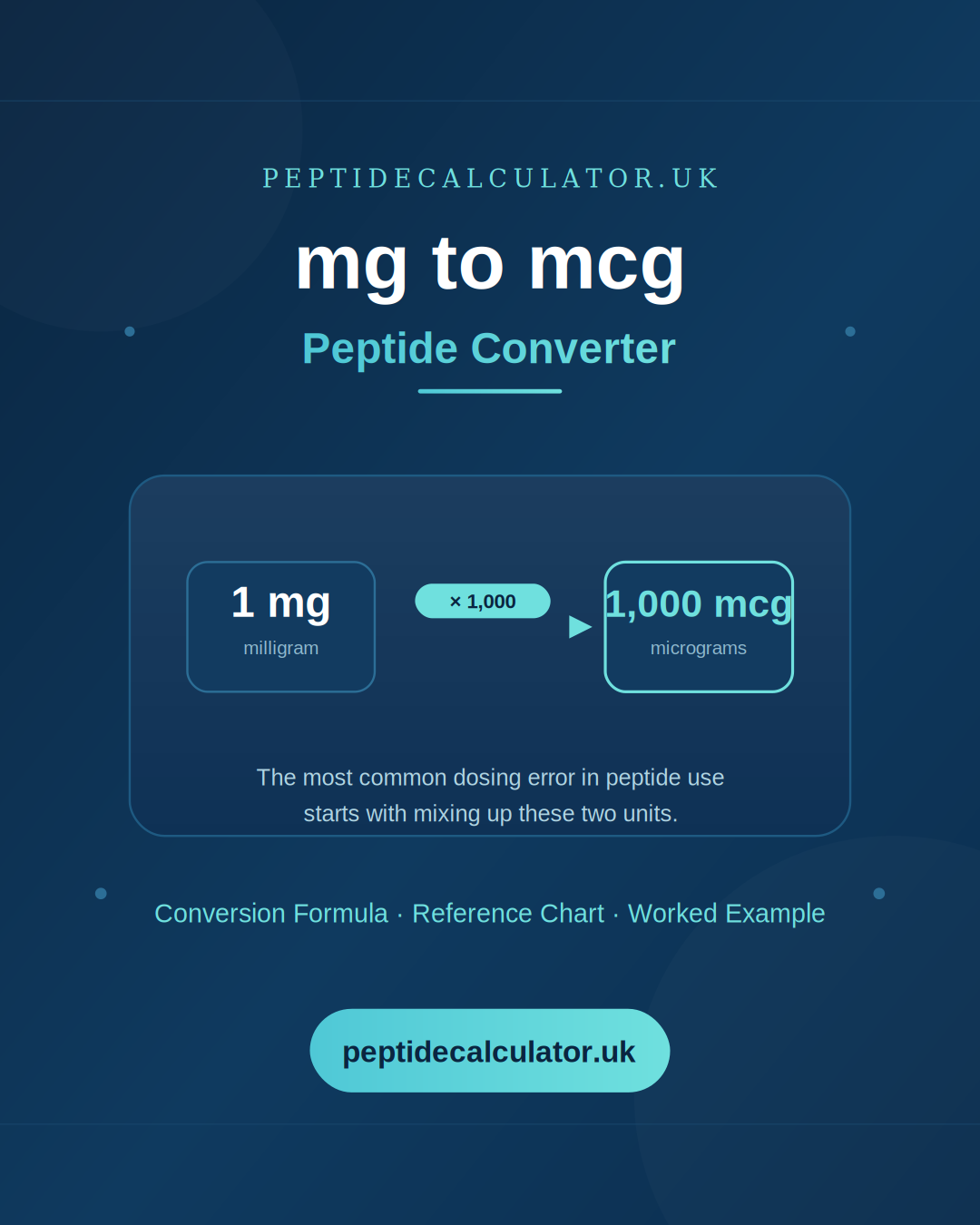
1 milligram (mg) = 1,000 micrograms (mcg)That's the entire relationship — but the risk isn't in the math itself, it's in which unit each number in front of you is actually using. Vials are almost always labeled in mg (e.g., "5mg vial"), while target doses are frequently discussed in mcg (e.g., "250mcg dose"). If you accidentally treat a 250mcg target as if it were 250mg, you'd be calculating a dose 1,000 times larger than intended.
Quick Reference Table
| Milligrams (mg) | Micrograms (mcg) |
|---|---|
| 0.1 mg | 100 mcg |
| 0.25 mg | 250 mcg |
| 0.5 mg | 500 mcg |
| 1 mg | 1,000 mcg |
| 2 mg | 2,000 mcg |
| 5 mg | 5,000 mcg |
| 10 mg | 10,000 mcg |
How This Fits Into the Full Dosing Calculation
The mg-to-mcg conversion is one piece of a larger formula used by any mg to mcg peptide converter or reconstitution calculator:
Units to draw = (Target dose in mcg ÷ (Vial mg × 1000)) × Water added (mL) × 100Notice the vial strength gets multiplied by 1,000 in this formula specifically to convert it from mg into mcg — so that both sides of the equation are working in the same unit before anything else happens. Skipping or miscalculating this step is where most manual math errors originate.
Worked Example
You have a 2mg vial reconstituted with 1mL of bacteriostatic water. Your target dose is 100mcg.
Step 1 — Convert vial strength to mcg:
2mg × 1000 = 2,000 mcg total in the vialStep 2 — Calculate the fraction of the vial needed:
100 mcg ÷ 2,000 mcg = 0.05 (5% of the vial)Step 3 — Apply that fraction to the water volume, converted to units:
0.05 × 1mL × 100 units = 5 unitsSo you'd draw 5 units on a U-100 syringe. A peptide calculator runs this exact sequence automatically the moment you enter your vial strength, water volume, and target dose — which is why using one is far safer than doing each step by hand under time pressure. For a deeper look at how the units-to-mL step works on the syringe itself, see our syringe unit conversion guide.
Why This Specific Mistake Is So Common
- Product labeling isn't standardized. Some suppliers label doses in mg, others in mcg, and some switch between the two even within the same product line.
- mcg is often just written as "mc" or abbreviated inconsistently, which can look similar to "mg" at a glance, especially on a small vial label or a phone screen.
- Verbal or forum-based dosing advice rarely specifies units clearly. "Take 250" means something very different depending on whether that's 250mg or 250mcg.
- Doses can look "reasonable" in either unit, which means a unit error doesn't always produce an obviously wrong-looking number — it can just look like a slightly different dose.
How to Protect Yourself From This Error
- Always write out the full unit — "mcg" or "mg" — rather than abbreviating further, both when noting your protocol and when entering numbers into a calculator.
- Double-check the vial label directly rather than relying on memory of "what it usually is."
- Use a calculator that requires you to explicitly select the unit for both vial strength and target dose, rather than one that assumes a single unit throughout.
- Cross-check your final unit count against a known reference dose — if a calculated syringe draw looks dramatically different from what you've drawn before for a similar dose, stop and re-verify the inputs before proceeding.
- Keep vial strength and target dose in different, clearly labeled fields when using an online peptide calculator, rather than typing both into a single free-text box where a unit could get lost.
Frequently Asked Questions
Why are peptide doses usually measured in mcg instead of mg? Because most peptide doses are extremely small relative to a full milligram — often in the range of tens to a few hundred micrograms. Expressing these as mg would mean working with awkward decimals (e.g., 0.00025mg), so mcg is used for practical readability.
Is there a faster way to double check my math without redoing the whole formula? Yes — a dedicated peptide dosage calculator handles the mg-to-mcg conversion as part of its standard calculation, so you only need to enter the vial strength and target dose once, in whichever unit each is labeled.
What should I do if a product doesn't clearly state its unit? Don't guess. Check the manufacturer's documentation, packaging, or certificate of analysis directly. If the unit still isn't clear, it's safer to hold off using the product until you can confirm it than to assume based on what's typical for similar products.
Does this conversion apply the same way across all peptides? Yes — the mg-to-mcg relationship is a fixed unit conversion (1mg = 1,000mcg) that applies universally, regardless of which specific peptide or compound you're working with.
Final Thoughts
The mg-to-mcg conversion is mathematically simple, but it's also the single highest-stakes conversion in the entire reconstitution process, because a mistake here scales your dose by a factor of 1,000 rather than a small percentage. Building the habit of writing out full units, double-checking vial labels, and running every calculation through a reliable peptide calculator is the most effective way to make sure this specific error never happens to you.
This article is for general education only. It is not medical advice. Always consult a licensed healthcare provider before using any peptide.