Peptide Blog Article
Peptide Dosage Calculator: Reconstitution Guide 2026.
Learn how to reconstitute peptides correctly with a free peptide dosage calculator. Step-by-step formulas, dosing mistakes to avoid, and safety tips.
Peptide Dosage Calculator: How to Reconstitute Peptides Correctly (Step-by-Step Guide 2026)
Getting a peptide dose wrong isn't a small mistake — it can mean injecting ten times too much or too little of a compound, wasting an entire vial, or introducing contamination during mixing. Yet most people reconstituting peptides at home are doing the math by hand, on a phone calculator, under time pressure, with a needle already in one hand.
That's exactly the gap a peptide dosage calculator is built to close. This guide walks through the correct reconstitution process step by step, the exact formulas involved, and how to avoid the errors that trip up even experienced users.
This article is for general education only. It is not medical advice. Always consult a licensed healthcare provider before using any peptide.
Why Reconstitution Math Goes Wrong So Often
Three things stack on top of each other every time you prep a dose:
- Unit mismatches — vials are labeled in milligrams (mg), but doses are almost always prescribed or discussed in micrograms (mcg). Missing a decimal point here is the single most common source of a 10x or 100x dosing error.
- Syringe markings — most syringes used for peptide work are marked in units, not milliliters. 1 mL equals 100 units on a standard U-100 insulin syringe, which is not intuitive if you haven't worked with one before.
- Variable concentration — the amount of bacteriostatic water you add changes the concentration of the solution every time, so a "250mcg dose" is a different number of units depending on how much water is in the vial.
Doing all three conversions mentally, especially under time pressure, is where mistakes creep in. This is precisely why a peptide reconstitution calculator exists — to remove the mental math from a process where a small slip has real consequences.
Step-by-Step: How to Reconstitute Peptides Correctly
1. Prepare your workspace
Wash your hands thoroughly and use sterile gloves if available. Wipe down your work surface, and lay out your peptide vial, bacteriostatic water, alcohol swabs, and syringe before you begin. Working in a clean, uncluttered space reduces the chance of contamination.
2. Let everything reach room temperature
Cold peptide powder and cold bacteriostatic water don't dissolve as evenly. Let both sit out for a few minutes before you start.
3. Sanitize the vial tops
Wipe the rubber stopper on both the peptide vial and the bacteriostatic water vial with an alcohol swab. Let it air dry for a few seconds.
4. Draw the correct amount of bacteriostatic water
This is where a bacteriostatic water calculator becomes useful — the volume you choose here determines your final concentration, which affects every dose you draw afterward. Common volumes range from 1mL to 3mL depending on your target dose size and how fine you want your syringe increments to be.
5. Inject the water slowly, along the vial wall
Insert the needle at an angle so the water runs down the inside wall of the vial rather than hitting the powder directly. This minimizes foaming, which can denature the peptide.
6. Swirl gently — never shake
Roll the vial between your palms until the powder is fully dissolved. Shaking introduces excess agitation that can damage the peptide's structure.
7. Label and store
Write the reconstitution date and concentration on the vial. Store it refrigerated and protected from light unless the manufacturer specifies otherwise.
8. Calculate your dose before every injection
Even with a correctly mixed vial, you still need to know how many units to draw for your specific target dose. This is where a peptide calculator is used every single time you prep a shot — not just once during mixing.
The Formulas Behind the Calculator
If you want to understand what's actually happening when you use an online peptide calculator, here are the three formulas involved:
Concentration (mg/mL):
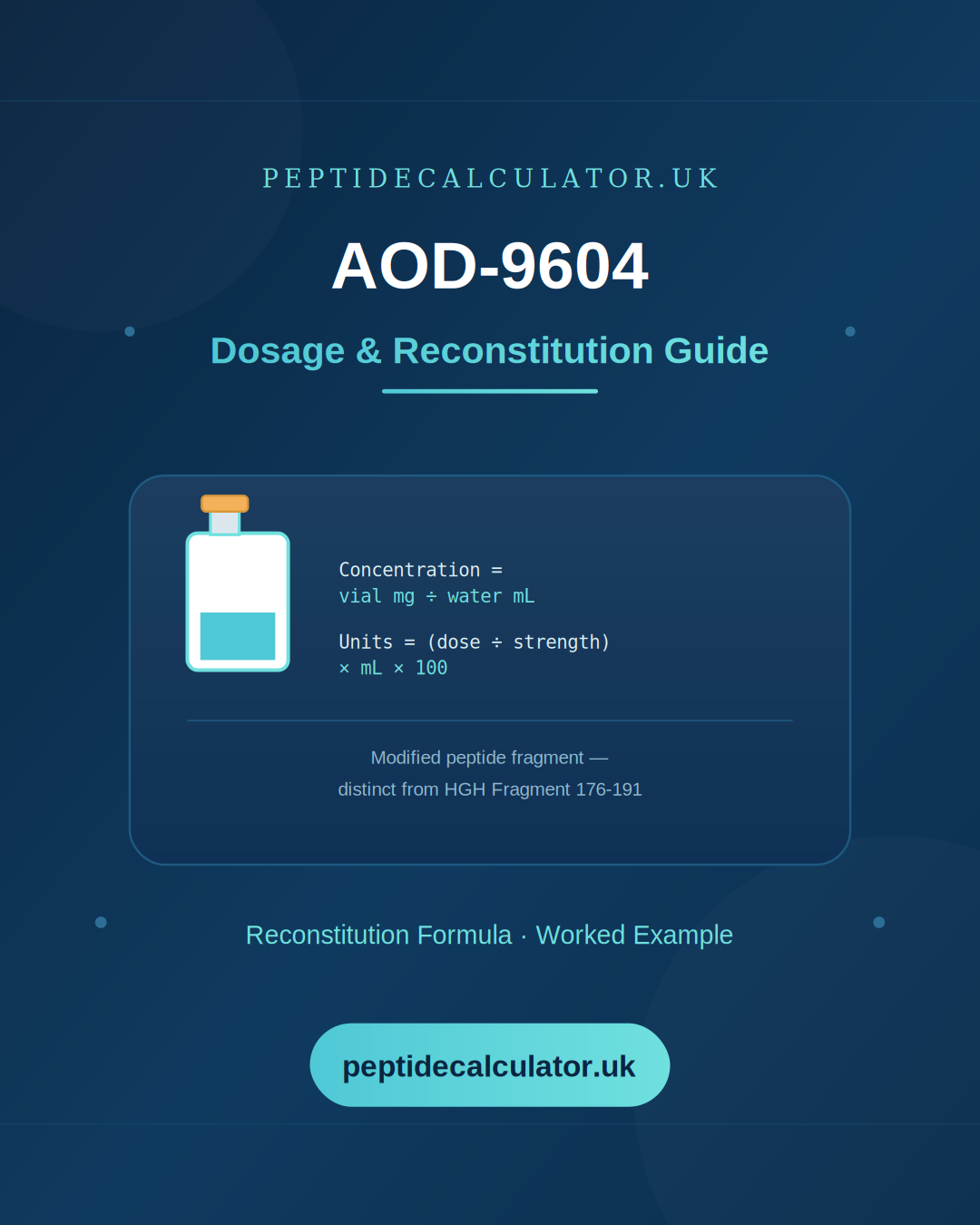
Concentration = Total peptide in vial (mg) ÷ Bacteriostatic water added (mL)Units to draw on a syringe:
Units = (Target dose in mcg ÷ (Vial mg × 1000)) × Water added (mL) × 100Total doses per vial:
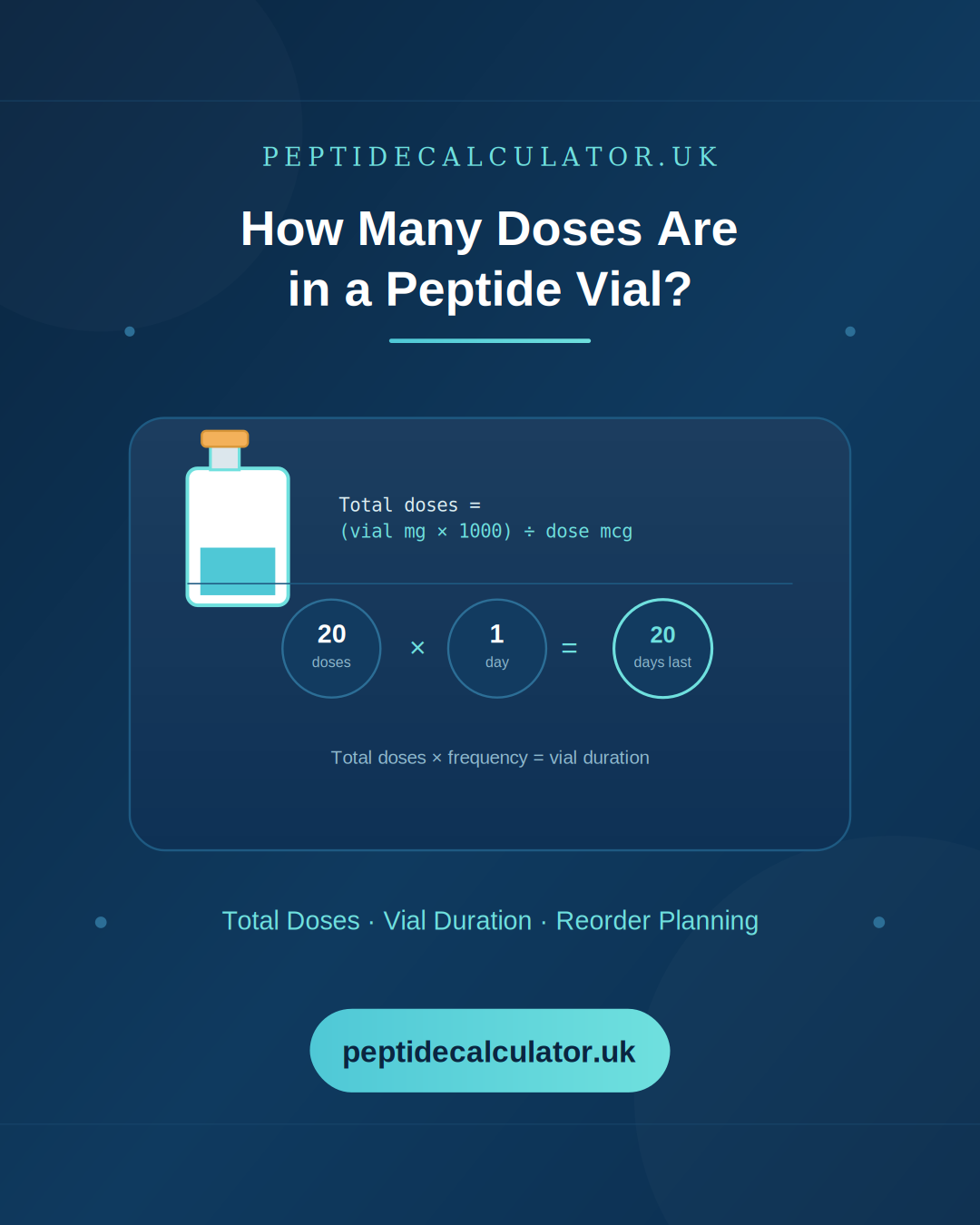
Doses per vial = (Vial mg × 1000) ÷ Target dose (mcg)Worked Example
Say you have a 5mg vial, and you reconstitute it with 2mL of bacteriostatic water. Your target dose is 200mcg.
- Concentration: 5mg ÷ 2mL = 2.5 mg/mL
- Units to draw: (200 ÷ 5000) × 2 × 100 = 8 units
- Doses per vial: 5000 ÷ 200 = 25 doses
So for this setup, you'd draw exactly 8 units on a U-100 syringe per dose, and the vial would last 25 doses total. Change the water volume to 3mL instead, and the units-per-dose number changes even though the total peptide amount didn't — which is exactly the kind of shift a peptide dosage calculator tracks for you automatically.
Common Reconstitution Mistakes to Avoid
- Mixing up mg and mcg. Always double-check which unit your target dose is written in before entering it into a calculator.
- Shaking instead of swirling. Vigorous agitation can break down the peptide before you've even used it.
- Injecting water directly onto the powder. This causes excessive foaming and can trap air bubbles that make accurate measurement harder.
- Reusing a syringe across multiple vials. Always use a fresh, sterile syringe for each draw to avoid cross-contamination.
- Guessing units instead of calculating them. A syringe pull that "looks about right" based on a previous batch is not reliable once your water volume or target dose changes.
- Forgetting to label the vial. Without a clear concentration label, you're relying on memory days or weeks later — a fast way to make a dosing error.
How to Choose a Reliable Peptide Calculator
- Handles both mg and mcg input without requiring you to convert manually
- Shows a visual syringe meter, not just a number, so you can double-check the draw at a glance
- Lets you save or preset common vial sizes (1mg, 5mg, 10mg, 15mg) for repeat protocols
- Works on mobile, since most people are reconstituting at a counter or desk, not sitting at a computer
- Is free for basic calculations — reconstitution math is a core function, not a premium feature, on most trustworthy tools
Frequently Asked Questions
How much bacteriostatic water should I use? It depends on your target dose and how many units you want each dose to take up on the syringe. More water means a more dilute solution and a higher unit count per dose; less water means a more concentrated solution and a lower unit count. A peptide mixing calculator can show you both outcomes instantly so you can pick what's easiest to measure accurately.
Can reconstituted peptides go bad? Yes. Once mixed, most peptides are stable for a few weeks when refrigerated, but this varies by compound. Always check manufacturer guidance and never use a solution that looks cloudy or discolored.
Do I need bacteriostatic water specifically, or can I use sterile water? Bacteriostatic water contains a preservative that allows a vial to be used safely across multiple doses over several weeks. Sterile water has no preservative and is generally intended for single-use only.
Is a peptide calculator accurate for GLP-1 medications like semaglutide or tirzepatide? Yes — the same reconstitution and dosing formulas apply. Just make sure you're entering the correct vial strength for that specific product.
Final Thoughts
Reconstituting peptides correctly comes down to three things: clean technique, the right water-to-peptide ratio, and accurate dose math every single time you draw a syringe. Manual calculation leaves room for exactly the kind of error that matters most — a misplaced decimal between mg and mcg. Using a dedicated peptide dosage calculator for both the initial mix and every dose afterward is the simplest way to remove that risk entirely.
This article is for general education only. It is not medical advice. Always consult a licensed healthcare provider before using any peptide.