Peptide Blog Article
How Much Does Each Peptide Dose Cost? A Vial Value Calculator Guide
A $150 vial isn't automatically cheaper than a $220 one — it depends on how many doses each provides. This guide walks through the exact formula to calculate true cost per dose so you can compare vials like-for-like
How Much Does Each Peptide Dose Cost? A Vial Value Calculator Guide
Peptide vials are priced as a single upfront number, but that number doesn't tell you what actually matters for comparison shopping: the cost of a single dose. A $150 vial and a $220 vial aren't necessarily "expensive" or "cheap" relative to each other until you know how many doses each one actually provides — which depends on the vial's total strength and your specific dosing protocol. This guide walks through how to calculate true cost per dose.
This article is for general education only. It is not medical or financial advice. Always verify current pricing directly with your supplier.
Why Vial Price Alone Is Misleading
Two vials can look very different in price while actually offering similar (or wildly different) value once you account for how many doses each provides. A 10mg vial priced at $180 and a 5mg vial priced at $100 aren't directly comparable on price alone — the 10mg vial may work out cheaper per dose, cost the same, or actually be more expensive depending on your specific target dose and how efficiently you reconstitute it.
The Cost-Per-Dose Formula
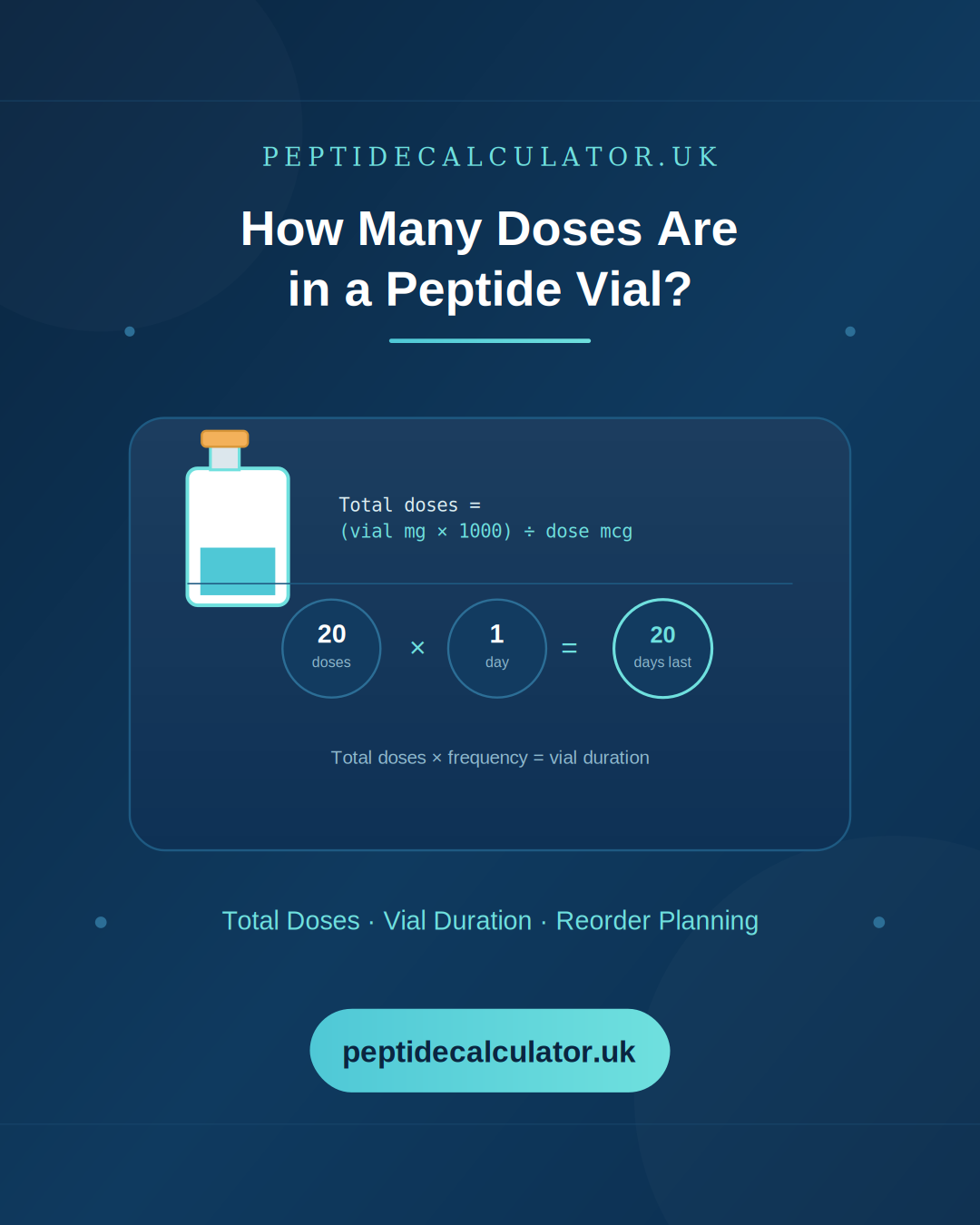
Total doses per vial = (Vial strength in mg × 1000) ÷ Target dose in mcg
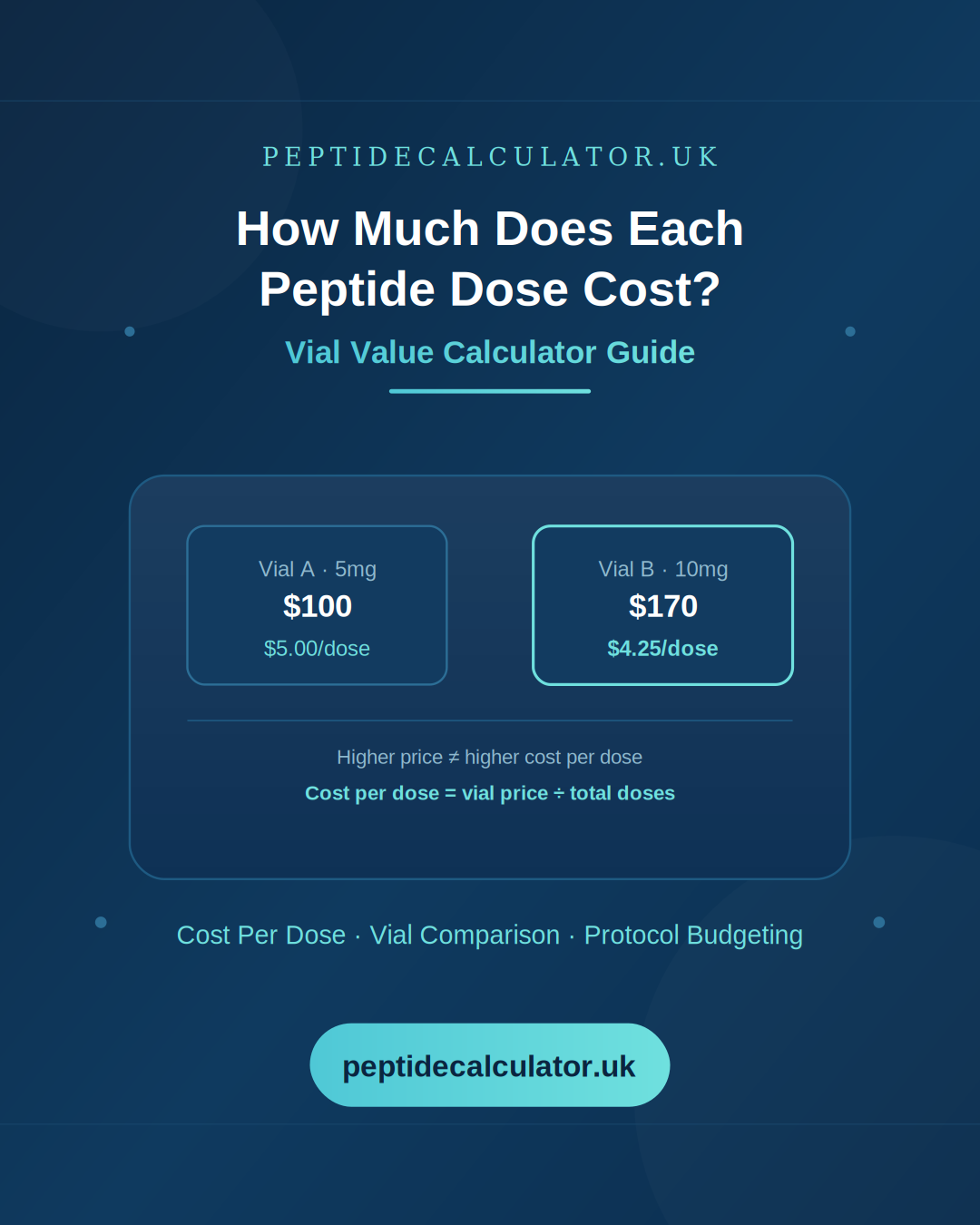
Cost per dose = Vial price ÷ Total doses per vial
Worked Example
Suppose you're comparing two vials of the same peptide:
Vial A: 5mg, priced at $100, target dose 250mcg
Total doses = (5 × 1000) ÷ 250 = 20 doses
Cost per dose = $100 ÷ 20 = $5.00 per dose
Vial B: 10mg, priced at $170, target dose 250mcg
Total doses = (10 × 1000) ÷ 250 = 40 doses
Cost per dose = $170 ÷ 40 = $4.25 per dose
Even though Vial B costs more upfront, it actually works out cheaper per dose. A peptide cost per dose calculator runs this comparison for you automatically — just enter each vial's strength, price, and your target dose to see which option is genuinely more cost-effective.
Cost Per mcg vs. Cost Per Dose
Some suppliers list pricing per mg, which can obscure true value if you're not converting it to your actual dose size. Cost per mcg is a useful intermediate figure for comparing raw pricing between suppliers, but cost per dose is what actually matters for your budget, since it reflects your real usage pattern rather than a raw unit price.
Cost per mcg = Vial price ÷ (Vial strength in mg × 1000)Using the Vial B example above: $170 ÷ 10,000mcg = $0.017 per mcg. At a 250mcg dose, that's $4.25 per dose — matching the calculation above, just approached from a different starting point.
Factoring In Reconstitution Waste
Your calculated "total doses per vial" assumes every microgram in the vial gets used. In practice, small amounts are sometimes lost to residual liquid left in the vial, syringe dead space, or an imprecise final draw. If you want a more conservative cost estimate, reduce your calculated total doses by a small buffer (some people use 5-10%) to account for this, rather than assuming perfect extraction from every vial.
Calculating Full Protocol Cost
If you're planning a multi-week protocol, you can extend the same formula to estimate total cost over time:
Total protocol cost = Cost per dose × Number of doses in protocolFor example, a 12-week protocol dosing once daily at $4.25 per dose:
12 weeks × 7 doses/week = 84 doses
84 × $4.25 = $357 total
This kind of full-protocol estimate is useful for comparing not just individual vials, but entire sourcing strategies — for instance, whether buying two smaller vials across a protocol costs more or less than one larger vial upfront.
Common Mistakes When Comparing Peptide Costs
- Comparing vial prices directly without adjusting for strength. A higher-priced vial can still be the better value once cost per dose is calculated.
- Ignoring your specific target dose. Cost per dose depends on how much you're actually using per injection, not just the vial's total content.
- Not accounting for reconstitution waste. A small buffer for imperfect extraction gives a more realistic cost estimate.
- Comparing cost per mg instead of cost per dose. These can tell different stories if your actual dose size varies from a round mg figure.
Frequently Asked Questions
Does a bigger vial always mean better value? Not necessarily — it depends on the price-to-strength ratio of that specific vial compared to smaller options. Always calculate cost per dose rather than assuming size alone determines value.
How do I compare peptide prices across different suppliers? Convert each supplier's pricing to a cost-per-mcg or cost-per-dose figure using the formulas above, so you're comparing equivalent numbers rather than raw vial prices that may reflect very different strengths.
Should I include reconstitution waste in my cost calculations? It's a reasonable practice if you want a more conservative, realistic estimate, since perfect extraction from every vial isn't typical. A 5-10% buffer is a commonly used starting point.
Is a lower cost per dose always the better choice? Cost is one factor among several relevant considerations, including supplier reliability and product quality. A peptide cost per dose calculator helps you make an informed price comparison, but price alone shouldn't be the only factor in a purchasing decision.
Final Thoughts
Comparing peptide vial prices at face value can be misleading — the vial that looks more expensive upfront is sometimes the better value once you calculate actual cost per dose. Running your specific target dose and vial options through a peptide cost per dose calculator gives you a clear, apples-to-apples comparison before you buy.
This article is for general education only. It is not medical or financial advice. Always verify current pricing directly with your supplier.