Peptide Blog Article
What Are the Best Peptide Tracker Apps?
Once you're managing more than one peptide, memory stops being a reliable tracking system. This guide covers what to look for in a peptide tracker — app, spreadsheet, or calculator-plus-log — and the features that matter most.
What Are the Best Peptide Tracker Apps?
Once you're managing more than one peptide, or running a protocol that spans several weeks, memory alone stops being a reliable way to track what you've injected, when, and how much is left in each vial. This guide covers what to actually look for in a peptide tracking system — whether that's a dedicated app, a general habit tracker, or a simple spreadsheet — and the features that matter most for staying organized.
This article is for general education only. It is not medical advice.
What a Peptide Tracker Actually Needs to Do
Before comparing specific tools, it helps to define what "tracking" means in this context. A useful system should let you record:
- What compound you injected (especially important if you're managing more than one)
- The exact dose and unit count drawn
- The date and time of each injection
- Injection site, if you're rotating locations
- Vial reconstitution date and concentration, so you can calculate remaining doses at a glance
- Remaining doses or estimated vial expiry, so you know when to reorder
Not every tool covers all of these — which is why the right choice depends on how many compounds you're managing and how detailed you want your records to be.
Types of Tracking Tools
General Habit or Medication Tracker Apps
Many general-purpose medication or habit-tracking apps can be adapted for peptide use by creating custom entries for each compound and dose. These tend to be strong on reminders and daily logging streaks, but usually don't have built-in reconstitution math or vial-duration calculations — you'd still need to work that out separately.
Dedicated Peptide or Research-Compound Tracking Apps
A smaller category of apps is built specifically around peptide or research-compound logging, sometimes including reconstitution calculators, injection site rotation diagrams, and vial inventory tracking in the same place. These tend to match peptide-specific workflows more closely, but availability and feature sets vary, so it's worth checking current app store listings and reviews directly, since this space changes frequently.
Spreadsheets
A simple spreadsheet remains one of the most flexible tracking options, since you can customize columns exactly to your protocol — compound, dose, date, site, vial remaining, and cost per dose can all live in one place. The tradeoff is that you're building and maintaining the structure yourself rather than using a pre-built interface, and there's no automatic reminder system unless you set one up separately.
A Peptide Calculator Plus a Simple Log
For many people, combining a reliable calculator for the reconstitution and dosing math with a basic log (paper, notes app, or spreadsheet) for the day-to-day record covers most needs without requiring a dedicated all-in-one app.
Features Worth Prioritizing
- Multi-compound support — if you're managing a stack (like ipamorelin and CJC-1295 together), look for a tool that can track each compound's remaining vial separately rather than lumping everything into one entry.
- Reminder scheduling — especially useful for protocols with changing frequency, like a loading-to-maintenance transition.
- Injection site rotation prompts — helps avoid repeatedly using the same site.
- Vial expiry or "doses remaining" tracking — ties directly into knowing when to reorder, which our doses-per-vial guide covers in more calculation depth.
- Export or backup capability — useful if you ever want to review your history or share it with a healthcare provider.
A Simple DIY Tracking Template
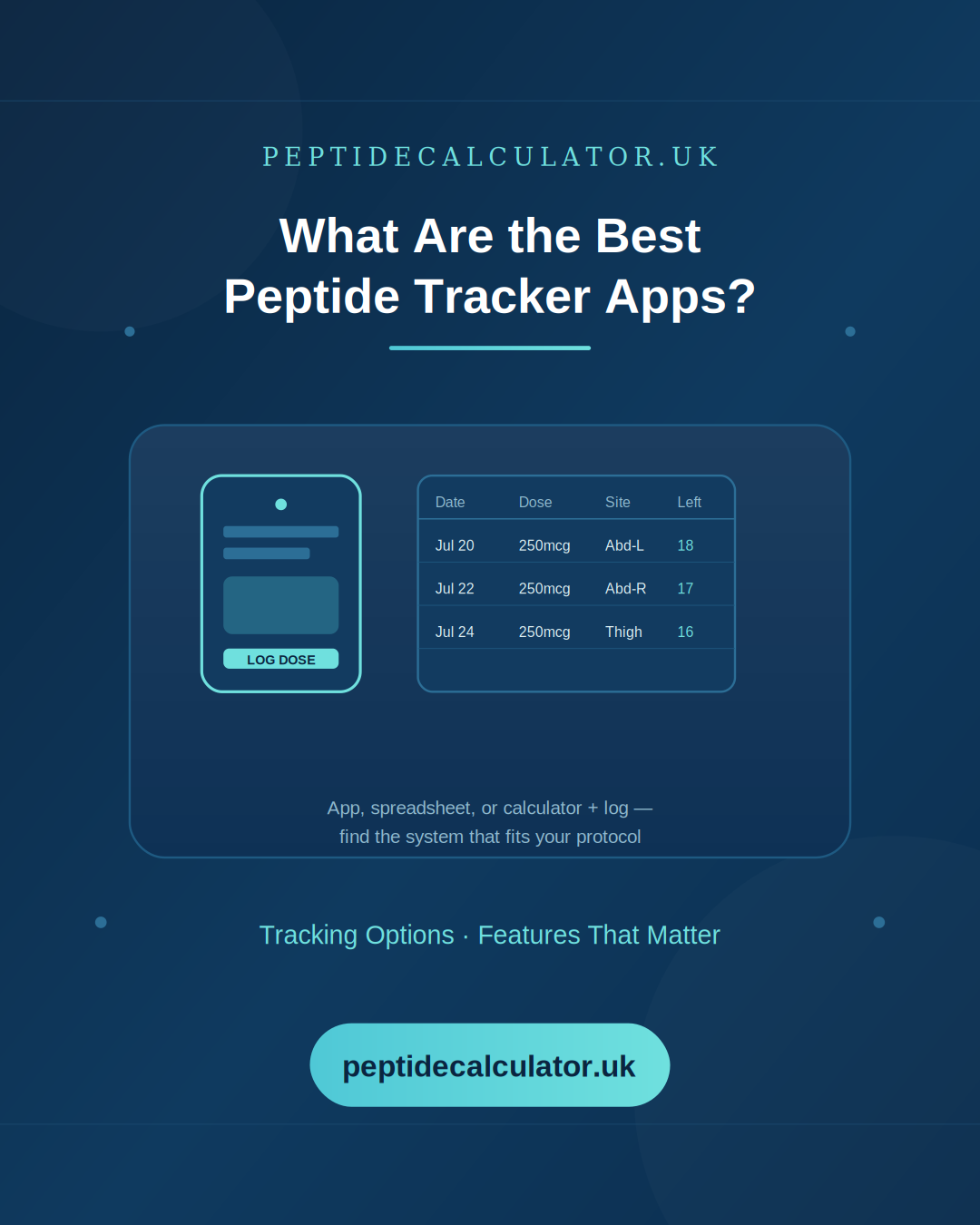
If you'd rather not rely on a dedicated app, a basic log with these columns covers most of what matters:
| Date | Compound | Dose | Units Drawn | Site | Vial Doses Remaining |
|---|---|---|---|---|---|
| — | — | — | — | — | — |
Pairing this with a peptide dosage tracker-style calculator for the reconstitution math itself gives you a complete system without needing a specialized app.
Common Mistakes When Tracking Peptide Use
- Relying on memory instead of a written or digital log, especially once managing more than one compound.
- Not recording injection site, making rotation harder to maintain consistently.
- Losing track of vial reconstitution dates, which makes it difficult to judge remaining shelf life.
- Using a general tracker without adapting it to include dose-specific and vial-specific fields.
Frequently Asked Questions
Do I need a dedicated app, or is a spreadsheet enough? This depends on how many compounds you're managing and how much automation (like reminders) you want. A spreadsheet is flexible and free but requires manual setup; a dedicated app trades some customization for built-in convenience.
What's the most important thing to track if I only log one thing? Injection date and vial remaining doses are the two most practically useful fields, since they directly inform when you're due for your next dose and when you'll need to reorder or reconstitute a new vial.
Can a peptide calculator double as a tracker? A calculator like peptidecalculator.uk handles the reconstitution and dosing math, but pairing it with a simple log (app, spreadsheet, or notebook) gives you the historical tracking piece that a calculator alone doesn't provide.
How do I track a stack of multiple peptides without mixing up the data? Keep each compound's entries clearly separated, either through distinct sections in a spreadsheet or separate entries in an app, especially since each compound will have its own vial concentration and remaining-dose count.
Final Thoughts
The "best" peptide tracking setup depends on your specific protocol complexity — a single-compound routine might only need a simple log, while a multi-compound stack benefits from a more structured system with reminders and per-vial tracking. Whichever method you choose, pairing it with an accurate peptide calculator for the underlying math ensures your tracked doses are correct in the first place.
This article is for general education only. It is not medical advice.