Peptide Blog Article
How Many Doses Are in a Peptide Vial?
Knowing how many doses a vial provides — and how long it will actually last — helps you budget, plan reorders, and avoid running out mid-protocol. This guide covers the exact formula plus a quick reference chart.
How Many Doses Are in a Peptide Vial?
Before reconstituting a vial, it's worth knowing how many total doses it will actually provide and how long it will last at your intended dosing frequency. This number depends on three things: the vial's total strength, your target dose size, and how often you're dosing — and getting it right helps you plan purchases, budget accurately, and avoid running out mid-protocol. This guide covers the calculation.
This article is for general education only. It is not medical advice. Always follow product-specific instructions and consult a healthcare provider before using any peptide.
The Total Doses Formula
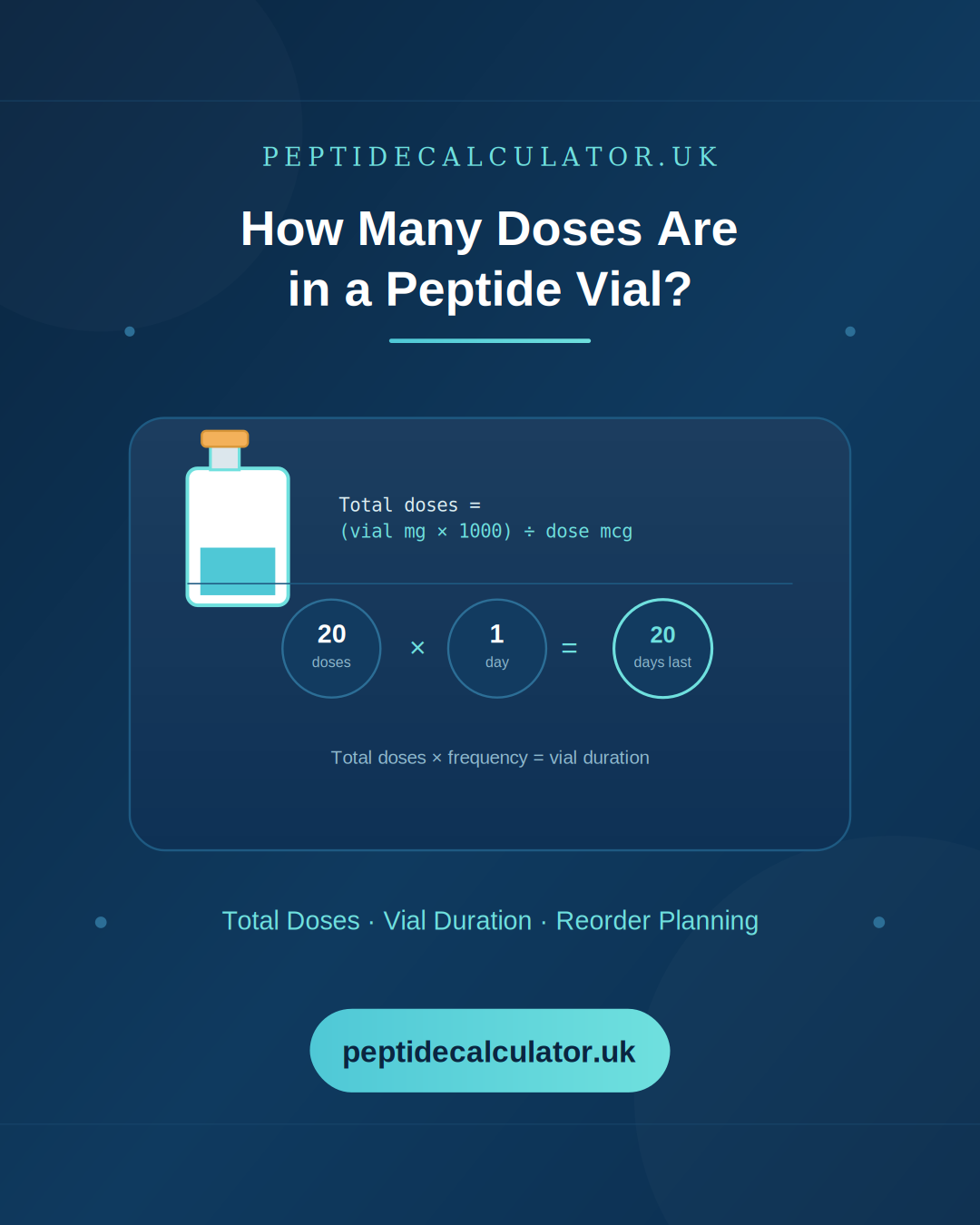
Total doses per vial = (Vial strength in mg × 1000) ÷ Target dose in mcgWorked Example
A 5mg vial, with a target dose of 250mcg:
Total doses = (5 × 1000) ÷ 250 = 20 dosesSo this vial provides 20 total doses at that dose size. A peptide vial duration calculator runs this automatically — enter your vial strength and target dose to see your total dose count instantly.
Turning Total Doses Into Vial Duration
Total doses only tells you part of the story — to know how long a vial will actually last, you need to factor in your dosing frequency.
Vial duration (days) = Total doses × Days between dosesWorked Example
Using the 20-dose vial above, dosed once daily:
Vial duration = 20 doses × 1 day = 20 daysIf instead you're dosing every other day:
Vial duration = 20 doses × 2 days = 40 daysThe same vial lasts twice as long simply by changing dosing frequency — which is why "how many doses" and "how long will this last" are related but distinct questions.
Quick Reference: Doses Per Vial at Common Strengths
| Vial Strength | Target Dose | Total Doses |
|---|---|---|
| 2mg | 100mcg | 20 doses |
| 5mg | 250mcg | 20 doses |
| 5mg | 100mcg | 50 doses |
| 10mg | 250mcg | 40 doses |
| 10mg | 500mcg | 20 doses |
This table illustrates how the same vial strength can produce very different total dose counts depending on your specific target dose — always calculate based on your own numbers rather than assuming a fixed figure applies universally.
Why This Calculation Matters for Planning
Knowing your total doses and vial duration in advance helps with a few practical things:
- Budgeting — combined with vial price, this tells you your true cost per dose (see our cost-per-dose guide for that full calculation).
- Reorder timing — knowing roughly when a vial will run out lets you order a replacement before you're left without one.
- Protocol length matching — if you're following a fixed-length protocol, you can choose a vial size that lines up closely with your total needed doses, minimizing leftover or shortfall.
Adjusting for Two-Phase Protocols
Some peptides, like TB-500, follow a loading-phase-then-maintenance structure where dosing frequency changes partway through. In these cases, calculate total vial duration in two segments rather than assuming a single flat frequency throughout — see our TB-500 calculator guide for a full worked example of this two-phase math.
Common Mistakes When Estimating Vial Duration
- Forgetting to factor in dosing frequency, and assuming "total doses" alone tells you how long a vial lasts.
- Not accounting for a change in frequency mid-protocol (such as a loading-to-maintenance transition).
- Assuming perfect extraction from every vial. Small amounts lost to residual liquid or syringe dead space can slightly reduce your actual total doses below the calculated figure.
- Recalculating from memory instead of vial-specific numbers. Always use your actual vial strength and target dose rather than assuming a previous calculation still applies to a new vial.
Frequently Asked Questions
How do I know how many doses are left in a partially used vial? Track how many doses you've already drawn since reconstitution, and subtract that from your originally calculated total. Keeping a simple log alongside your vial label makes this easy to reference.
Does vial duration change if I switch target dose mid-protocol? Yes — if you increase or decrease your dose partway through, recalculate your remaining doses based on the new target dose and the amount of peptide remaining in the vial, rather than assuming your original total-doses figure still applies.
Can I use this calculation for any peptide? Yes — the total-doses and vial-duration formulas apply universally, since they're based on vial strength, target dose, and dosing frequency rather than anything specific to a particular compound.
Should I buy a bigger vial if it lasts longer? A longer-lasting vial isn't automatically better value — check your cost per dose (not just total doses) before deciding, since a larger vial's price doesn't always scale proportionally with its strength.
Final Thoughts
Calculating total doses and vial duration in advance turns vial purchasing from a guess into a plan — you'll know roughly how long a vial will last and when to expect needing a replacement. Running your specific vial strength, target dose, and frequency through a peptide calculator gives you both numbers at once, rather than working them out separately by hand.
This article is for general education only. It is not medical advice. Always follow product-specific instructions and consult a healthcare provider before using any peptide.