Peptide Blog Article
Peptide Units to Syringe: The Complete Conversion Guide
Confused about what "20 units" actually means on a syringe? This guide breaks down the exact formula for converting peptide doses into syringe units, a quick-reference conversion chart, and the most common mistakes that lead to inaccurate draws.
Peptide Units to Syringe: The Complete Conversion Guide
If you've ever stared at a syringe barrel trying to figure out whether "20 units" means 0.2mL or something else entirely, you're not alone. Syringe markings are one of the most consistently confusing parts of peptide dosing — and getting the conversion wrong is one of the easiest ways to under- or over-dose.
This guide breaks down exactly how syringe units work, how they relate to milliliters and milligrams, and how to convert between them reliably every time.
This article is for general education only. It is not medical advice. Always consult a licensed healthcare provider before using any peptide.
Why Syringes Are Measured in "Units," Not mL
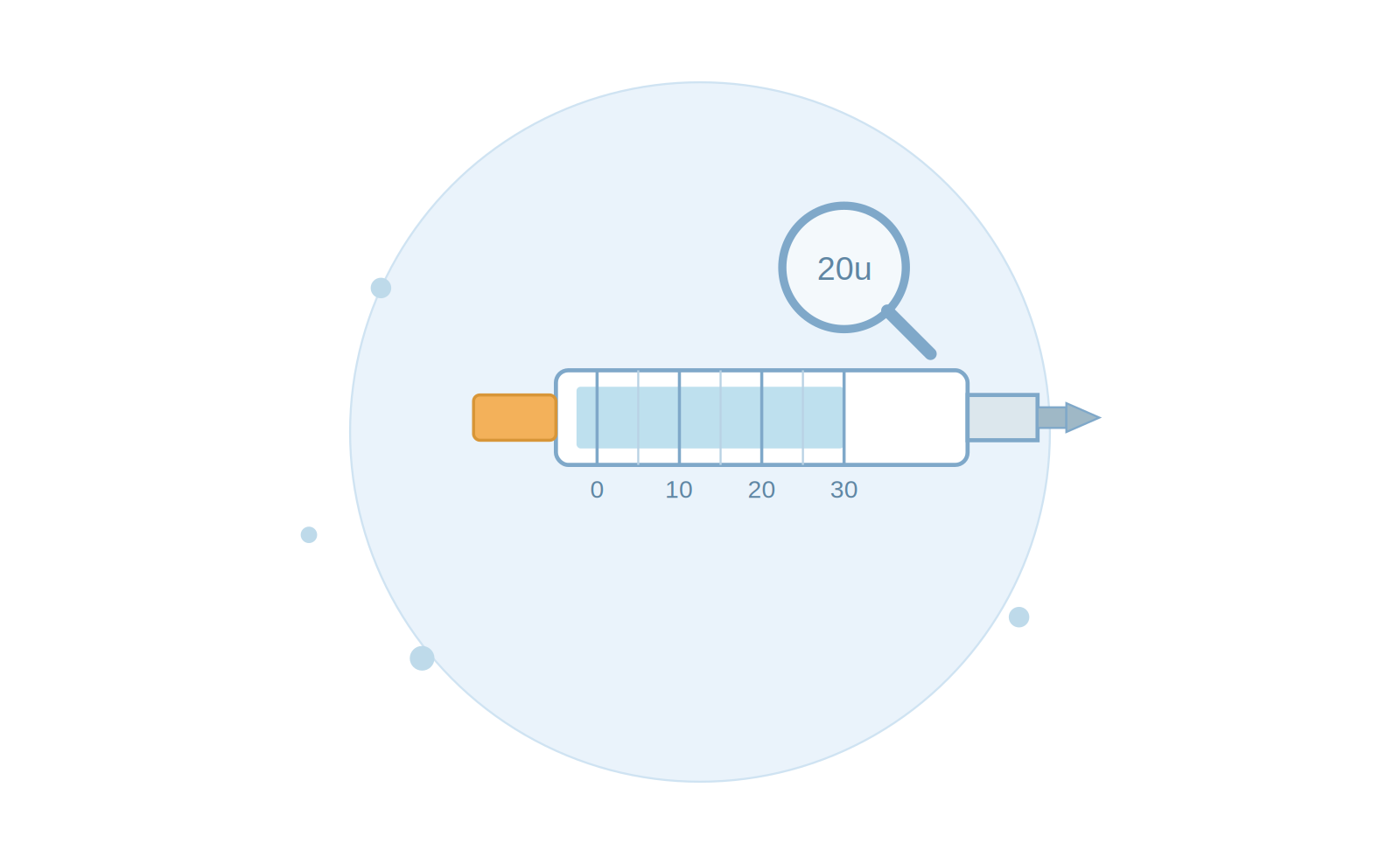
Most peptide work is done with insulin syringes, which were originally designed for insulin dosing — not peptides. These syringes are marked in units, where:
100 units = 1 mL (on a standard U-100 syringe)This means every unit on the barrel equals 0.01mL. If your syringe shows "30 units" drawn up, that's 0.3mL of liquid — not 30mL, and not 3mL. This single misunderstanding is behind a huge number of dosing mistakes, especially for people switching from oral medications or unfamiliar with injectable dosing.
Some syringes are U-40 or U-50 instead of U-100, which changes the math entirely — always check the barrel markings before assuming.
The Core Conversion Formula
To go from a target dose (in mcg or mg) to the number of units you need to draw, you need three numbers:
- Vial strength — how many mg of peptide are in the vial
- Reconstitution volume — how much bacteriostatic water you added
- Target dose — how many mcg (or mg) you want to inject
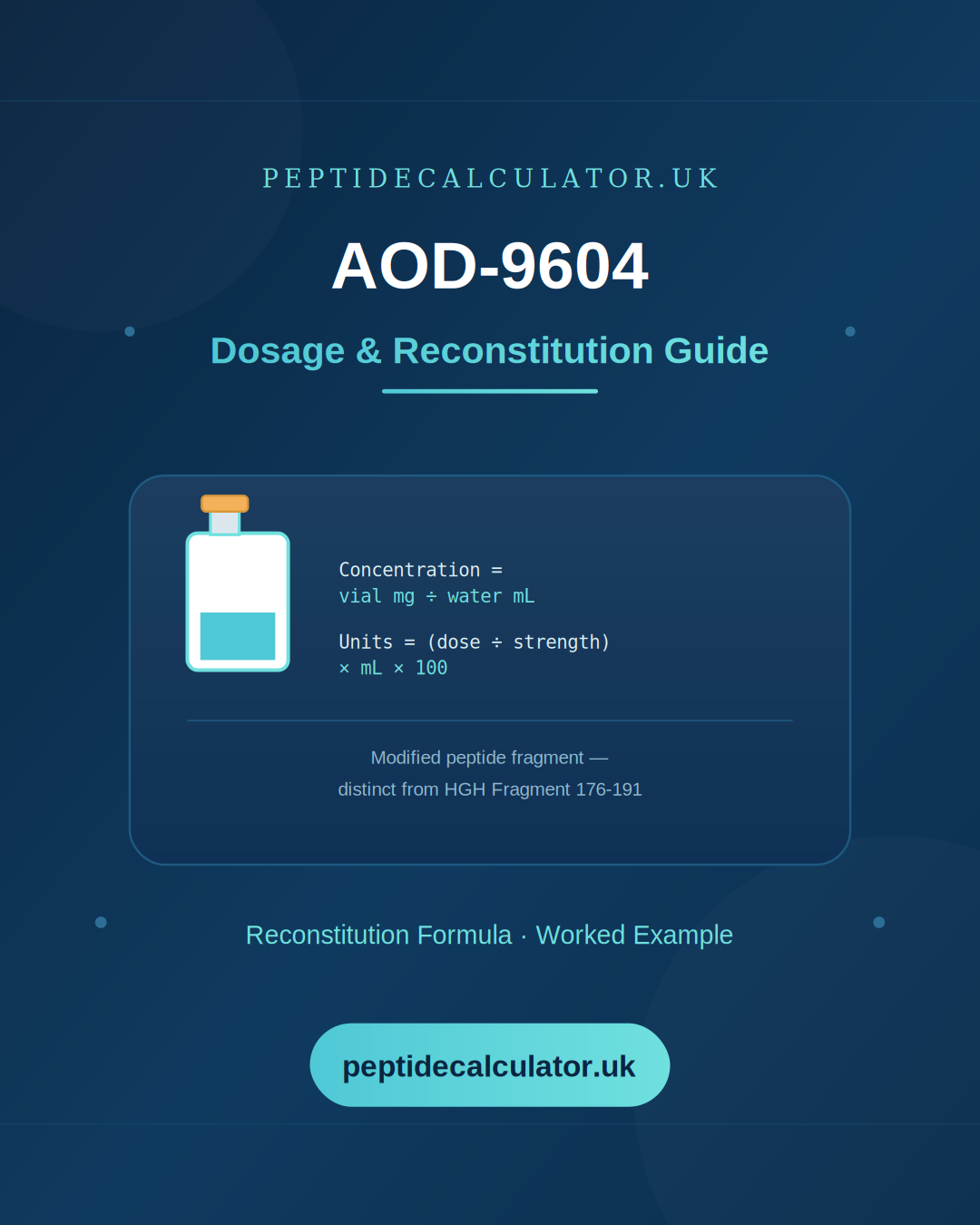
The formula:
Units to draw = (Target dose in mcg ÷ (Vial mg × 1000)) × Water added (mL) × 100Worked Example
You have a 10mg vial, reconstituted with 2mL of bacteriostatic water. Your target dose is 300mcg.
Units = (300 ÷ 10,000) × 2 × 100 = 6 unitsSo you'd draw exactly 6 units on a U-100 syringe. Note how sensitive this number is to your water volume — if you'd used 3mL instead of 2mL, the same 300mcg dose would require 9 units instead of 6.
This is exactly the kind of variable, easy-to-miscalculate conversion a peptide units to syringe calculator is built to handle instantly, without you needing to redo the formula by hand every time your water volume changes. If you haven't reconstituted your vial yet, it's worth starting with our full reconstitution walkthrough before you get to the syringe-drawing step.
Quick Reference: Common Unit-to-mL Conversions
| Syringe Units | Milliliters (mL) |
|---|---|
| 5 units | 0.05 mL |
| 10 units | 0.10 mL |
| 20 units | 0.20 mL |
| 25 units | 0.25 mL |
| 50 units | 0.50 mL |
| 100 units | 1.00 mL |
Keep in mind this table only applies to U-100 syringes, which are the most common type used for peptide work. Always confirm your syringe type before relying on any conversion chart.
Why This Trips People Up So Often
- Assuming units = mL. They're not the same — units are a syringe-specific scale, mL is a volume measurement.
- Using the wrong syringe type. A U-40 syringe has a completely different unit-to-mL ratio than a U-100, so charts and calculators built for one won't work for the other.
- Forgetting that water volume changes the unit count. The same target dose can require a completely different number of units depending on how much bacteriostatic water was used during reconstitution.
- Reading the barrel at the wrong angle. Parallax error — looking at the syringe from an angle rather than straight on — can make the plunger appear to be at a different unit mark than it actually is.
How to Draw an Accurate Dose Step by Step
- Calculate your target units using the formula above, or run it through a peptide calculator.
- Insert the needle into the reconstituted vial.
- Draw slightly past your target unit mark to account for any air bubbles.
- Tap the syringe gently to bring air bubbles to the top.
- Push the plunger back down to your exact target unit mark, expelling the excess air.
- Confirm the reading at eye level, straight on to the barrel — not at an angle.
Frequently Asked Questions
What's the difference between a U-100 and U-40 syringe? U-100 syringes are calibrated so 100 units equal 1mL — this is the standard used for most peptide and insulin dosing. U-40 syringes use a different scale (40 units = 1mL) and are far less common for peptide work. Mixing up the two types is a common source of significant dosing errors.
Can I use a regular mL-marked syringe instead? Some people do, particularly for larger doses, but unit-marked syringes generally allow for more precise small-volume dosing, which matters for peptides where doses are often measured in single-digit or low double-digit microgram amounts relative to the vial.
Why does my unit count change every time I reconstitute a new vial? Because the amount of bacteriostatic water you add changes the concentration of the solution. Even if the vial strength and target dose stay the same, a different water volume means a different final unit count. A peptide dosage calculator recalculates this automatically so you don't have to track it manually across different batches.
What if my target dose is written in mg instead of mcg? You'll need to convert it first before applying the units formula above. See our mg to mcg conversion guide for a full breakdown of that step, since mixing up the two is one of the most common sources of a miscalculated syringe draw.
Is there a way to avoid recalculating every time? Using a consistent reconstitution volume across all your vials (for example, always using 2mL) means your unit-per-dose numbers stay consistent between refills, which many people find easier to work with day to day.
Final Thoughts
Syringe unit conversion is simple once you understand the underlying scale, but it's also one of the easiest places for small errors to compound — especially when water volume changes between vials. Running the numbers through a dedicated online peptide calculator before every dose removes the guesswork and gives you a visual confirmation of exactly where the plunger should sit.
This article is for general education only. It is not medical advice. Always consult a licensed healthcare provider before using any peptide.