Peptide Blog Article
Semaglutide Dosage Calculator: Complete Dosing Guide
Semaglutide is one of the most searched GLP-1 medications, and vial-based dosing brings the same reconstitution math as other peptides. This guide covers the formula, an illustrative worked example, and why your actual dose should always come from your prescriber — not a general calculator.
Semaglutide Dosage Calculator: Complete Dosing Guide
Semaglutide is one of the most widely discussed GLP-1 medications, and it's also one of the most common places where people run into reconstitution and dosing confusion — particularly when working with compounded or research-format vials rather than pre-filled pens. This guide covers how the underlying math works so you can verify any dose against your prescriber's instructions.
This article is for general education only and does not provide medical dosing recommendations. Semaglutide is a prescription medication. Always follow the exact dose, schedule, and instructions provided by your prescribing healthcare provider — never determine your own dose from this or any online calculator.
Why Semaglutide Dosing Math Gets Confusing
Semaglutide is typically supplied in one of two formats:
- Pre-filled pens, which are pre-dosed and don't require reconstitution math
- Multi-dose vials (common with compounded formulations), which require the same reconstitution and syringe-draw calculations used for other peptides
If you're working with a vial rather than a pen, the same core variables apply: vial strength (mg), the amount of diluent added, and your prescribed target dose (usually expressed in mg). The confusion typically comes from the same places as any peptide calculation — mg-to-mcg mix-ups, and unit-vs-mL confusion on the syringe. If you're new to this process, our reconstitution walkthrough and syringe unit conversion guide cover both of those steps in detail.
The Formula
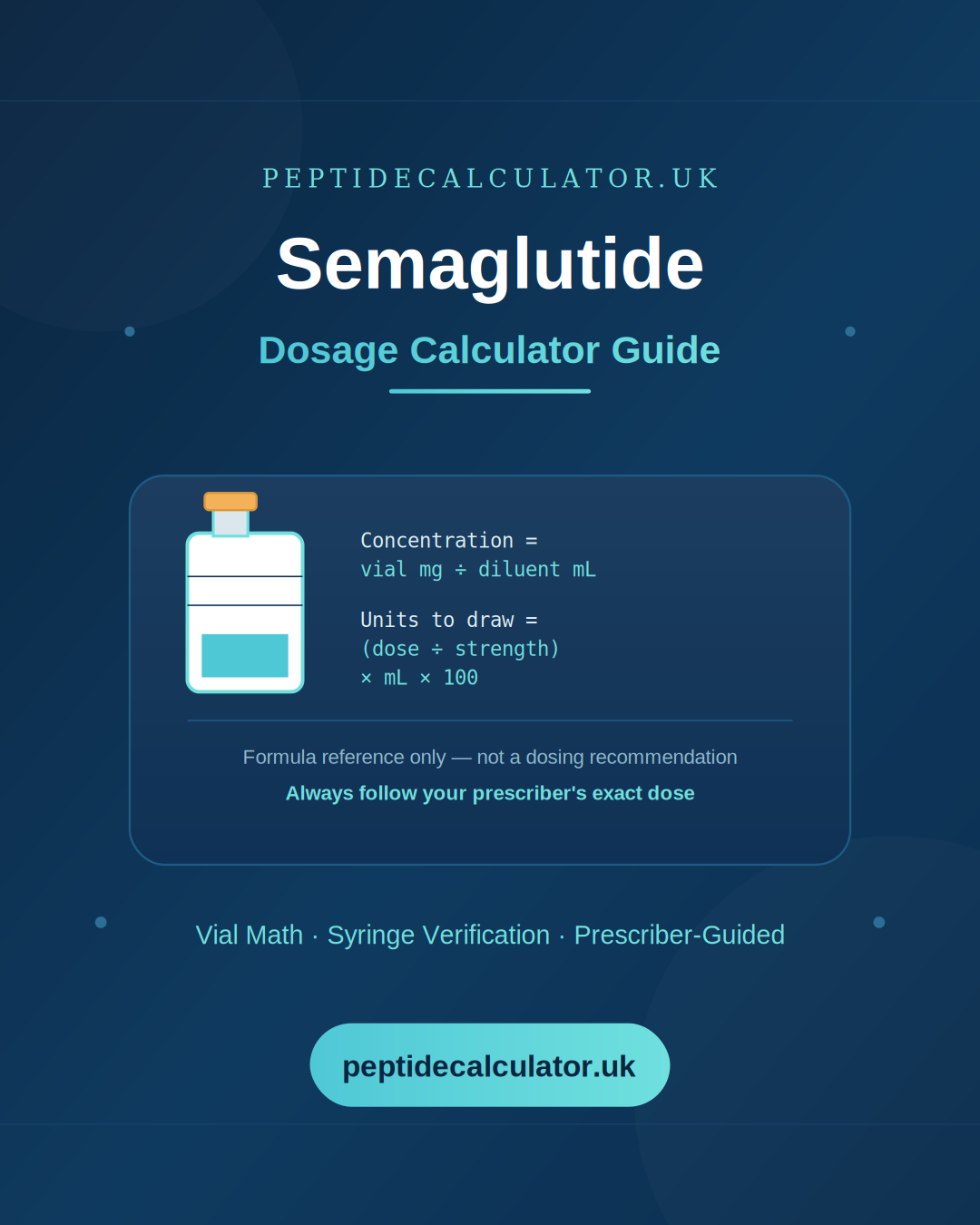
Concentration (mg/mL) = Total semaglutide in vial (mg) ÷ Diluent added (mL)
Units to draw = (Prescribed dose in mg ÷ Vial strength in mg) × Diluent (mL) × 100
Illustrative Example (formula demonstration only — not a dosing recommendation)
Suppose a vial is labeled as containing 5mg of semaglutide, and it has been reconstituted with 2mL of diluent per the product's specific reconstitution instructions. If a prescriber has directed a dose of 0.25mg:
Units to draw = (0.25 ÷ 5) × 2 × 100 = 10 unitsThis example exists purely to illustrate how the formula works. Your actual vial strength, diluent volume, and prescribed dose will be specific to your product and prescription — always use the exact numbers provided by your prescriber or pharmacy, not example figures from an article.
A semaglutide calculator automates this formula so you can cross-check your prescribed dose against your specific vial's numbers, rather than relying on manual arithmetic.
What You Need Before Calculating Anything
- Your vial's exact labeled strength (in mg) — this varies significantly between products and suppliers
- The exact diluent volume specified in your product's reconstitution instructions — this is not something to estimate or standardize across different products
- Your prescribed dose, exactly as directed by your prescriber — never a dose sourced from a forum, a friend's protocol, or a general "typical dose" figure found online
Common Mistakes With Semaglutide Vial Dosing
- Using a standardized water volume instead of the product-specific one. Reconstitution instructions vary by manufacturer — always follow the specific instructions that came with your vial.
- Confusing total vial mg with per-dose mg. A "5mg vial" does not mean a single dose is 5mg — it means the vial contains enough medication for multiple doses at your prescribed amount.
- Not accounting for titration schedules. Semaglutide dosing is typically titrated upward over time under medical supervision — recalculate your syringe draw every time your prescribed dose changes.
- Treating dosing instructions found online as personal medical guidance. Dosing schedules vary by individual, medical history, and prescriber judgment — no calculator or article should be treated as a substitute for that guidance.
Why This Isn't a "Try This Dose" Article
Unlike some research peptides where individuals may follow self-directed protocols, semaglutide is an FDA-regulated prescription medication (in the US) with equivalent regulatory status in the UK, EU, and Australia. Its dosing is titrated carefully based on individual response, tolerance, and medical history — this is why this article deliberately avoids listing "common" or "typical" dose ranges. The only appropriate source for your dose is your prescribing clinician.
What this article — and a peptide dosage calculator — can help with is verifying the syringe math for a dose your prescriber has already given you, so you can double-check your own calculation before injecting.
Frequently Asked Questions
Can I use a general peptide calculator for semaglutide? Yes — the underlying reconstitution and syringe-draw math is the same formula used across peptides. Just make sure you're entering your specific vial's strength and diluent volume, not a generic or example figure.
Is it safe to determine my own semaglutide dose without a prescription? No. Semaglutide requires medical supervision due to its titration schedule, potential side effects, and the need for individualized dosing based on your health history. A calculator can help verify the math for a dose already prescribed to you — it should never be used to determine what dose to take in the first place.
Why do compounded semaglutide vials sometimes have different concentrations than pens? Compounding pharmacies formulate vials to their own specifications, which can differ from the standardized concentrations used in commercially manufactured pens. This is exactly why using the product-specific reconstitution instructions — rather than a generic assumption — matters so much.
What should I do if my calculated units don't match what I expected? Stop and recheck your inputs — vial strength, diluent volume, and prescribed dose — before drawing anything. If the discrepancy persists, contact your pharmacy or prescriber rather than proceeding.
Final Thoughts
The math behind semaglutide vial dosing follows the same reconstitution logic as other peptides, but the stakes around getting it right — and the source of the dose itself — are different, since this is a prescription medication with individualized, medically supervised dosing. Use an online peptide calculator to verify your syringe draw against numbers your prescriber has given you, and always follow your product's specific reconstitution instructions over any general example. If you're comparing this against a different GLP-1 medication, our tirzepatide calculator guide follows the same calculation structure.
This article is for general education only and does not provide medical dosing recommendations. Always follow your prescribing healthcare provider's exact instructions.