Peptide Blog Article
Melanotan 2 (MT2) Calculator: Dosage Explained
Melanotan 2 (MT2) Calculator: Dosage Explained
Melanotan 2 (MT2) doses typically sit in a very small microgram range, which makes reconstitution accuracy especially important — a decimal error that might be a minor issue at higher doses can represent a substantial proportional error at MT2's typical dose sizes. This guide covers the reconstitution formula, a worked example, and the practical details around vial sizing and storage.
This article is for general education only. It is not medical advice. Melanotan 2 is not an FDA-approved drug and is intended for research purposes. Consult a licensed healthcare provider before using any peptide.
Why MT2 Dosing Requires Extra Precision
MT2 vials are typically labeled in mg (commonly 10mg per vial), while individual doses are usually discussed in a low mcg range — often starting well under 500mcg. Because the numbers involved are small relative to the total vial strength, even a modest miscalculation in your water volume or unit conversion can shift your actual dose meaningfully. This is exactly the scenario where using a calculator instead of manual math matters most.
The Reconstitution Formula
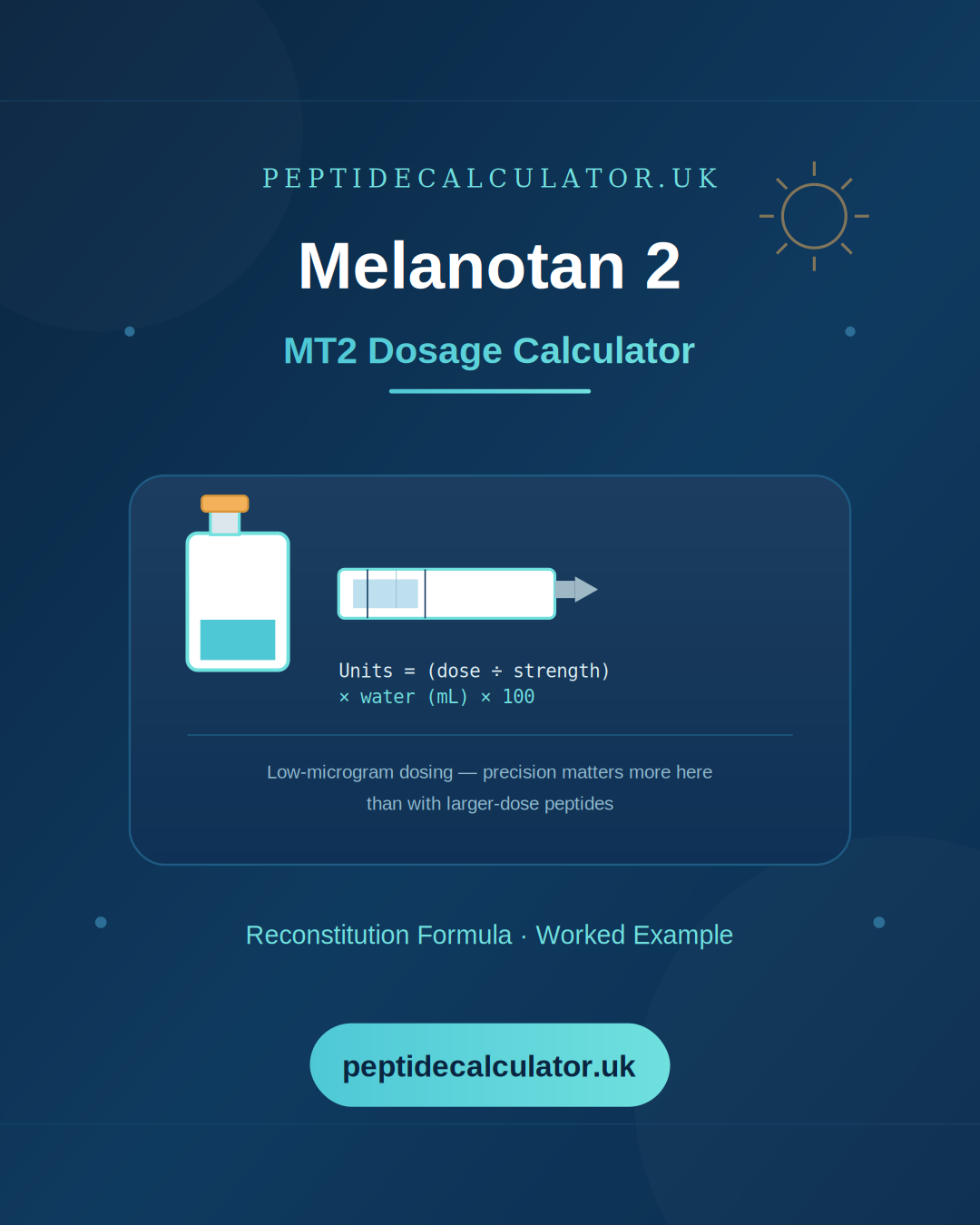
Concentration (mg/mL) = Total MT2 in vial (mg) ÷ Bacteriostatic water added (mL)
Units to draw = (Target dose in mcg ÷ (Vial mg × 1000)) × Water added (mL) × 100
Worked Example
Suppose you have a 10mg vial of MT2, reconstituted with 2mL of bacteriostatic water, and your target dose is 250mcg.
Units to draw = (250 ÷ 10,000) × 2 × 100 = 5 unitsSo you'd draw 5 units on a U-100 syringe. Notice how small this number is — at this scale, even a 1-unit misread on the syringe represents a 20% change in the actual dose delivered, which illustrates why precision matters more here than with peptides dosed in larger amounts.
A melanotan 2 calculator removes this risk by calculating the exact unit count for you. If the underlying mg-to-mcg step is still unclear, our conversion guide breaks that down separately, and our units-to-syringe guide covers reading the syringe itself.
MT2 Vial Size Comparison
MT2 is commonly available in a few standard vial sizes, and the choice mostly comes down to how concentrated you want your solution and how many total doses you want a vial to provide.
| Vial Size | With 2mL Water | Doses at 250mcg |
|---|---|---|
| 10mg | 5 mg/mL | 40 doses |
| 5mg | 2.5 mg/mL | 20 doses |
| 2mg | 1 mg/mL | 8 doses |
A MT2 calculator lets you test different vial sizes and water volumes against your intended dose before you purchase, so you can pick the combination that gives you a practical syringe reading and a reasonable number of total doses.
How to Reconstitute Melanotan 2
- Bring the vial and bacteriostatic water to room temperature.
- Sanitize both vial tops with an alcohol swab.
- Draw your chosen volume of bacteriostatic water.
- Inject the water slowly down the inside vial wall to minimize foaming.
- Swirl gently until fully dissolved — never shake.
- Label the vial with the reconstitution date and calculated concentration.
- Store refrigerated, protected from light.
For the general process in more depth, see our full reconstitution guide.
Storage After Mixing
Once reconstituted, MT2 should be kept refrigerated and used within the timeframe specified by your supplier's documentation. Watch for cloudiness, discoloration, or visible particles, which indicate a vial should no longer be used regardless of how much time has passed.
Common Mistakes With MT2 Dosing
- Underestimating how much a small unit error matters. Because typical doses are low, a 1-2 unit misread has a larger proportional impact than it would with a higher-dose peptide.
- Miscalculating mg-to-mcg. This remains the most common source of significant dosing errors across all peptides, MT2 included.
- Not testing vial size against intended dose count before purchasing. Running the numbers in advance avoids ending up with an impractical concentration.
- Skipping vial labeling. Without a clear concentration label, it's easy to lose track of your exact numbers over time, especially at this scale where small differences matter.
Frequently Asked Questions
Why are MT2 doses so much smaller than some other peptides? This comes down to how MT2 is typically discussed and used — its low mcg dosing range is simply a feature of the compound, not something you can adjust by changing vial size. What you can control is the concentration you mix, which affects how many units that small dose translates to on the syringe.
How much bacteriostatic water should I use for MT2? This depends on your target dose and how many units you want each draw to represent. A MT2 dosage calculator lets you test a few different water volumes to find a syringe reading that's easy to measure accurately and repeat consistently.
How long does reconstituted MT2 last? This varies by manufacturer. Always check your specific product's documentation, and don't use a vial that shows any signs of contamination or discoloration, even if it's within an expected timeframe.
Is there a "starter dose" I should calculate first? This article intentionally doesn't recommend specific dose amounts, since appropriate starting points are protocol- and individual-specific. A calculator can help you verify the math for whatever dose you've decided on through your own research or guidance, but it isn't a source for determining that number in the first place.
Final Thoughts
MT2's characteristically low microgram dosing makes precise reconstitution math more important than with many other peptides — small errors have an outsized proportional effect at this scale. Testing your vial size and water volume choices through a peptide calculator before you begin, and recalculating carefully for every dose, is the most reliable way to keep your actual dose consistent with your intended one.
This article is for general education only. It is not medical advice. Melanotan 2 is not an FDA-approved drug and is intended for research purposes. Consult a licensed healthcare provider before using any peptide.