Peptide Blog Article
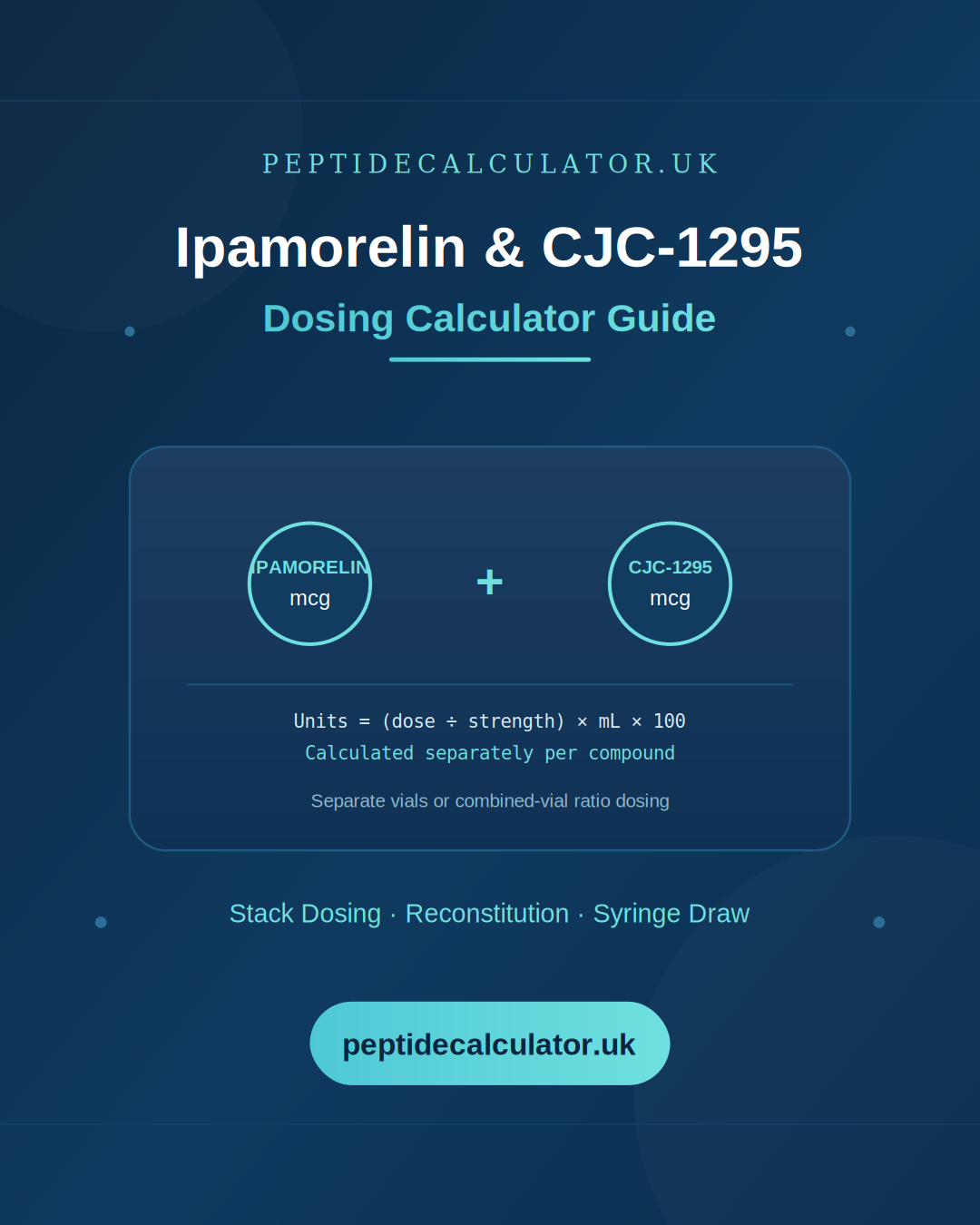
Ipamorelin & CJC-1295 Calculator: Dosing Both Together
Ipamorelin and CJC-1295 are frequently used together as a growth hormone-releasing stack. This guide breaks down how to calculate each compound's dose individually, plus how combined-vial math works.
Ipamorelin & CJC-1295 Calculator: Dosing Both Together
Ipamorelin and CJC-1295 are two of the most commonly paired research peptides, typically combined into what's referred to as a growth hormone-releasing stack. Because they're often reconstituted and dosed together, the math involves an extra layer compared to a single-peptide calculation — you're tracking two separate concentrations, and sometimes two separate vials, within the same protocol. This guide breaks down how to calculate each compound individually and how combined-vial dosing works.
This article is for general education only. It is not medical advice. These compounds are not FDA-approved drugs and are intended for research purposes. Consult a licensed healthcare provider before using any peptide.
Why This Pairing Needs Its Own Explanation
Ipamorelin and CJC-1295 are frequently discussed together because of how their mechanisms are commonly understood to complement each other, but from a dosing-math perspective, they're just two separate peptides that happen to often be reconstituted in the same session — sometimes in the same vial, sometimes in two separate ones. Each scenario changes how you calculate your syringe draw.
Scenario 1: Two Separate Vials
This is the simpler case. Each peptide is reconstituted on its own, and you calculate each dose independently using the standard formula:
Units to draw = (Target dose in mcg ÷ (Vial mg × 1000)) × Water added (mL) × 100Worked Example — Ipamorelin
5mg vial, reconstituted with 2mL of bacteriostatic water, target dose 200mcg:
Units to draw = (200 ÷ 5,000) × 2 × 100 = 8 unitsWorked Example — CJC-1295
2mg vial, reconstituted with 2mL of bacteriostatic water, target dose 100mcg:
Units to draw = (100 ÷ 2,000) × 2 × 100 = 10 unitsIn this scenario, you'd draw each peptide into the syringe separately (or combine them into a single syringe just before injecting, depending on your protocol), using two independently calculated unit counts.
Scenario 2: Combined in a Single Vial
Some protocols reconstitute both peptides together in one vial — for example, mixing 5mg of ipamorelin and 2mg of CJC-1295 into the same vial with a shared volume of bacteriostatic water. In this case, each peptide has its own concentration within that shared volume, and you need to calculate each one's contribution to the total draw separately, then confirm the combined unit count makes sense for both target doses simultaneously.
Worked Example — Combined Vial
Suppose both 5mg ipamorelin and 2mg CJC-1295 are reconstituted together in 2mL of bacteriostatic water. Target doses: 200mcg ipamorelin and 100mcg CJC-1295.
Ipamorelin units = (200 ÷ 5,000) × 2 × 100 = 8 units
CJC-1295 units = (100 ÷ 2,000) × 2 × 100 = 10 units
Notice these two numbers don't match — meaning a single syringe draw can't hit both target doses exactly unless the ratio of the two peptides in the vial is adjusted so their required unit counts align. This is precisely the kind of calculation an ipamorelin calculator that supports multi-compound input can solve for you, rather than requiring manual trial and error with different vial ratios.
How to Reconstitute an Ipamorelin/CJC-1295 Stack
- Decide whether you're using separate vials or a combined vial — this determines which calculation method above applies.
- Bring peptides and bacteriostatic water to room temperature.
- Sanitize vial tops with an alcohol swab.
- Add bacteriostatic water slowly along the vial wall, whether reconstituting one peptide or both together.
- Swirl gently until fully dissolved — never shake.
- Label clearly, especially if using a combined vial, noting both compounds' concentrations and the date mixed.
- Store refrigerated, protected from light.
For the general mixing process in more depth, see our full reconstitution guide. If you're unsure how the mg-to-mcg step works within these formulas, our conversion guide covers that separately.
CJC-1295 With vs. Without DAC
CJC-1295 is available in two forms — with DAC (a modification that extends its activity duration) and without DAC (sometimes referred to by its unmodified name). These two forms are not interchangeable in terms of typical dosing frequency or protocol structure, and vial strengths can vary between suppliers offering each version. Always confirm which specific form your vial contains before running any calculation, since treating one as equivalent to the other is a common point of confusion.
Common Mistakes With Stack Dosing
- Assuming both peptides in a combined vial will always produce matching unit counts. As shown above, this only happens by design, not by default — the ratio needs to be deliberately calculated.
- Mixing up CJC-1295 with and without DAC. These have different typical protocols and shouldn't be treated as the same product.
- Forgetting to label combined vials with both concentrations. A single "reconstituted on [date]" note isn't enough information to calculate future doses accurately.
- Applying a single-peptide formula to a two-peptide vial without adjusting for each compound's individual strength.
Frequently Asked Questions
Can I use a standard peptide calculator for a stack, or do I need something different? A calculator that only accepts one vial strength at a time will require you to run the formula twice — once per compound — and manually compare the results. A CJC-1295 calculator or ipamorelin tool built for stacking makes this easier by handling both calculations in the same interface.
Do ipamorelin and CJC-1295 need to be reconstituted with the same amount of water? Not necessarily — if kept in separate vials, each can use whatever water volume makes its own dosing math convenient. It's only when combined into a single vial that a shared volume needs to be accounted for in both calculations simultaneously.
Is it better to keep them in separate vials or combine them? This is a practical and protocol-specific decision. Separate vials give you more flexibility to adjust each dose independently; a combined vial is more convenient per-injection but requires more careful upfront ratio planning.
What happens if my calculated unit counts don't match in a combined vial? This means the current water volume and peptide ratio don't produce equal unit counts for your two target doses. You can either accept drawing two syringes (one from each vial, if applicable) or recalculate a water volume/ratio that brings the two numbers closer together.
Final Thoughts
Dosing ipamorelin and CJC-1295 together adds a layer of complexity beyond single-peptide reconstitution, mainly because you're tracking two independent concentrations that may or may not share a vial. Whether you keep them separate or combine them, running each compound's numbers through a dedicated peptide calculator — rather than estimating — is the most reliable way to make sure both doses land where you intend.
This article is for general education only. It is not medical advice. These compounds are not FDA-approved drugs and are intended for research purposes. Consult a licensed healthcare provider before using any peptide.