Peptide Blog Article
IU Peptide Calculator: Dosing HGH and HCG Correctly
International Units (IU) aren't a fixed weight like mg or mcg — they measure biological activity, which means the conversion differs between compounds. This guide breaks down how IU dosing works for HGH and HCG specifically, with formulas and worked examples for each.
IU Peptide Calculator: Dosing HGH and HCG Correctly
IU Peptide Calculator: Dosing HGH and HCG Correctly
International Units (IU) are one of the more confusing measurements in peptide and hormone dosing, mainly because — unlike mg or mcg — an IU isn't a fixed unit of mass. It's a standardized measure of biological activity, which means the conversion to mg or mcg differs from compound to compound. This makes IU-based dosing, most commonly seen with HGH and HCG, a frequent source of confusion.
This guide breaks down what IU actually means, how it differs for HGH versus HCG, and how to convert it correctly into a syringe draw. If you're working with a standard mg/mcg-labeled peptide instead, our mg to mcg conversion guide covers that separate unit system.
This article is for general education only. It is not medical advice. Always consult a licensed healthcare provider before using any peptide or hormone product.
What Does "IU" Actually Mean?
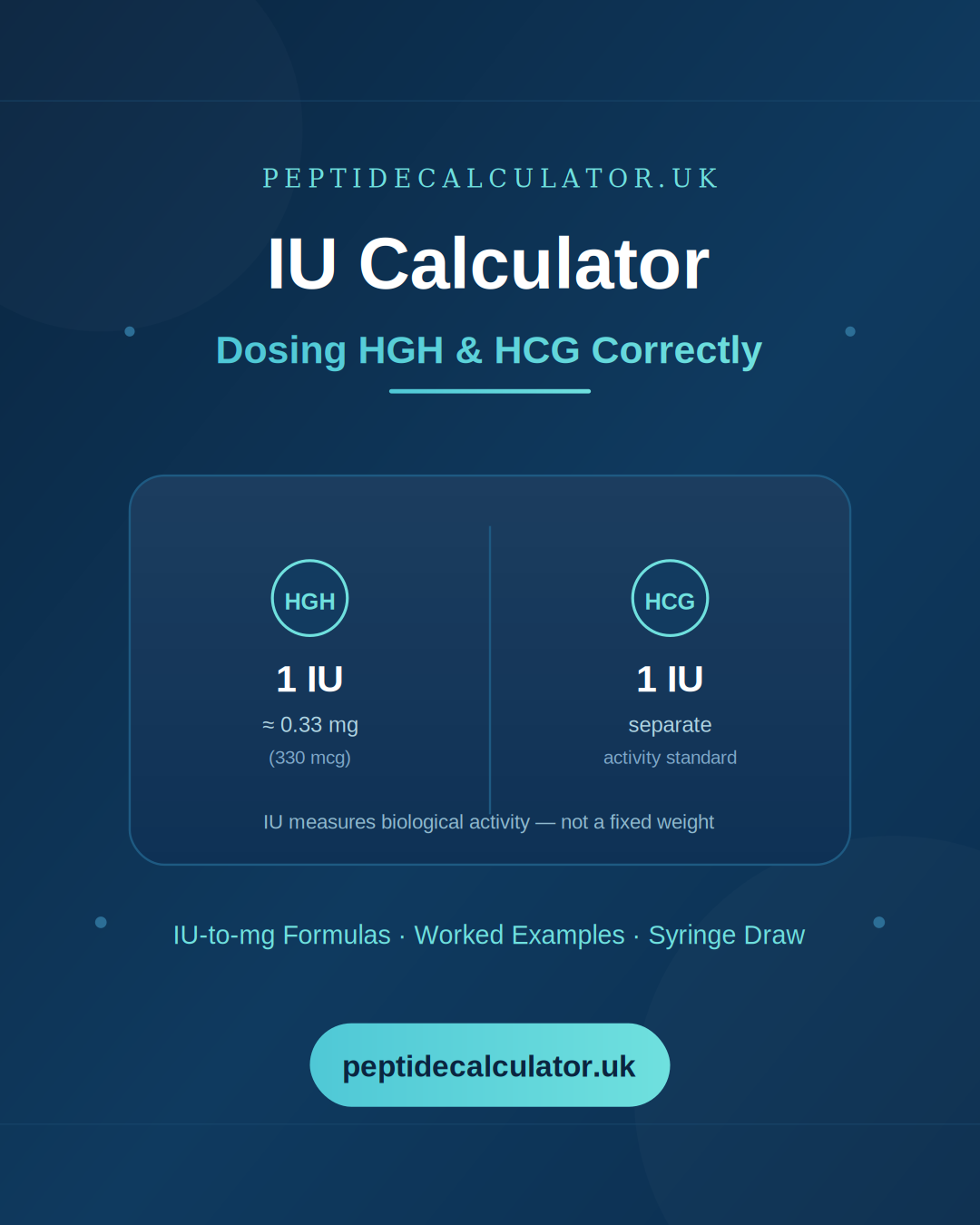
An International Unit is a measurement of a substance's biological effect, defined by international pharmaceutical standards — not a fixed weight like mg or mcg. This is why the same number of IU can represent a different mass depending on the specific compound:
- 1 IU of HGH is commonly standardized as approximately 0.33mg (330mcg), though labeling conventions vary by manufacturer
- 1 IU of HCG relates to its own separate biological activity standard and is not interchangeable with the HGH conversion
Because these conversion factors are compound-specific, you cannot apply an mg-to-mcg style formula uniformly across every IU-labeled product. Always check the specific product's labeling or manufacturer documentation for its IU-to-mg equivalence before calculating a dose.
HGH: Converting IU to a Syringe Draw
HGH vials are typically labeled in IU (e.g., "10 IU vial"), but reconstitution and dosing still follow the same underlying logic as any other peptide:
Concentration = Total IU in vial ÷ Water added (mL)
Units to draw = (Target IU ÷ Total IU in vial) × Water added (mL) × 100
Worked Example
You have a 10 IU HGH vial, reconstituted with 1mL of bacteriostatic water. Your target dose is 2 IU.
Units to draw = (2 ÷ 10) × 1 × 100 = 20 unitsSo you'd draw 20 units on a U-100 syringe for a 2 IU dose. This is the same structural formula used by an IU peptide calculator, just with IU substituted in place of mg as the vial's labeled strength — the same syringe-reading principles from our units-to-syringe guide still apply once you've calculated the number.
HCG: A Separate Conversion Standard
HCG is also commonly dosed in IU, but its biological standard is distinct from HGH's. A typical HCG vial might be labeled as "5,000 IU" or "10,000 IU" — numbers that look very different from HGH's "10 IU" vials, purely because the two hormones use different reference standards for what constitutes one unit of activity.
The calculation structure is the same:
Units to draw = (Target IU ÷ Total IU in vial) × Water added (mL) × 100Worked Example
You have a 5,000 IU HCG vial, reconstituted with 2mL of bacteriostatic water. Your target dose is 250 IU.
Units to draw = (250 ÷ 5,000) × 2 × 100 = 10 unitsSo you'd draw 10 units on a U-100 syringe. Notice how much larger the raw IU numbers are for HCG compared to HGH — this is exactly why compound-specific accuracy matters, and why a generic mg-based calculator isn't the right tool for IU-labeled products.
Why IU Dosing Deserves Extra Caution
- IU is not a universal conversion. Unlike mg-to-mcg (always 1,000:1), the IU-to-mg relationship changes based on the specific compound's biological standard.
- Vial strengths vary enormously between products. A 10 IU HGH vial and a 10,000 IU HCG vial look nothing alike in scale, even though both use "IU" as the labeled unit.
- Manufacturer standards can differ. Always confirm the specific IU equivalence stated by the product's own documentation rather than assuming a generalized figure applies.
- Mixing up HGH and HCG conversion factors is a realistic risk if you're working with both compounds in the same session — treat each vial's math independently.
How a Calculator Helps With IU-Based Dosing
A reliable peptide calculator that supports IU-based inputs lets you enter the vial's total IU strength directly — rather than forcing you to manually convert to mg first — which removes an extra, compound-specific conversion step that's easy to get wrong. This matters more for IU-labeled products than for standard mg/mcg peptides, precisely because there's no fixed universal conversion factor to fall back on.
Frequently Asked Questions
Is 1 IU the same across every hormone or peptide? No. IU represents biological activity, which is standardized separately for each compound. 1 IU of HGH does not represent the same mass or effect as 1 IU of HCG or any other IU-labeled substance.
How do I find the correct IU-to-mg conversion for my specific product? Check the product packaging, manufacturer's certificate of analysis, or official product documentation. Don't rely on generalized conversion figures found informally, since labeling conventions can vary between manufacturers.
Can I use the same online peptide calculator for both mg/mcg peptides and IU-based products? Yes, as long as the calculator allows you to input the vial's labeled strength in its native unit (IU, mg, or mcg) and doesn't force a single unit type across all calculations.
Why do HGH vials show such small IU numbers compared to HCG vials? Because the two hormones use entirely separate biological activity standards — the numbers aren't meant to be compared directly against each other, only within their own compound's dosing context.
Final Thoughts
IU-based dosing for HGH and HCG follows the same reconstitution logic as any other peptide, but with one critical difference: there's no fixed, universal conversion factor between IU and mg. Always confirm the specific product's IU standard before calculating a dose, and use a peptide dosage calculator built to handle IU inputs directly rather than manually converting between unit systems.
This article is for general education only. It is not medical advice. Always consult a licensed healthcare provider before using any peptide or hormone product.