Peptide Blog Article
What Peptides Help With Anti-Aging?
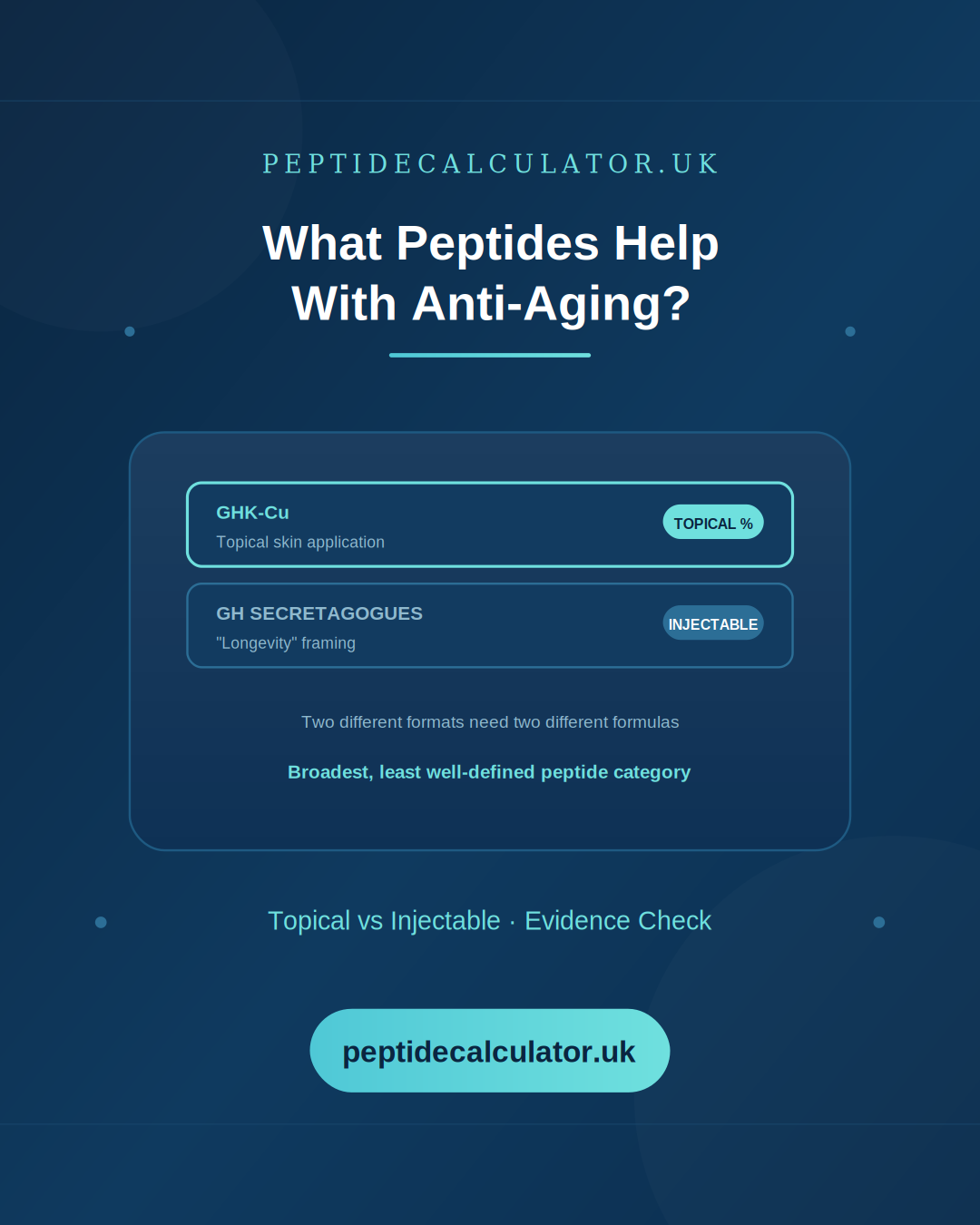
Anti-aging is the broadest, least well-defined peptide category, blending topical skincare compounds with injectable longevity-framed peptides. This guide separates what's actually being discussed under this umbrella term.
What Peptides Help With Anti-Aging?
"Anti-aging" is one of the broadest peptide search categories, and it tends to blend together several genuinely different compounds and use cases — topical skin products, growth hormone secretagogues, and general wellness-oriented research peptides all get grouped under this single umbrella. This guide breaks apart what's actually being discussed under the anti-aging label.
This article is for general education only. It is not medical advice. Consult a licensed healthcare provider or dermatologist before starting any anti-aging regimen.
GHK-Cu: The Topical Skin Category
As with hair growth, GHK-Cu shows up prominently in anti-aging discussions, here specifically in the context of topical skin application. This is the same compound and the same topical concentration-based calculation covered in our GHK-Cu guide — commercial skincare products commonly list GHK-Cu at varying concentrations, and the relevant math is a percentage-based formula rather than the injectable reconstitution process used elsewhere on this site.
Amount of GHK-Cu per application = Product concentration (%) × Amount appliedGrowth Hormone Secretagogues: The "Longevity" Framing
Peptides like ipamorelin, CJC-1295, and sermorelin sometimes appear in anti-aging discussions under a "longevity" or "youthful hormone levels" framing, tied to their role in growth hormone release. This is a different mechanism and context from GHK-Cu's topical skin application, and the evidence base for anti-aging specifically (as opposed to their more commonly discussed research contexts) is generally less established. See our ipamorelin & CJC-1295 and sermorelin guides for the dosing specifics if you're researching this category.
Why "Anti-Aging" Is a Particularly Broad, Loosely Defined Category
Unlike weight loss (which has a specific, measurable outcome and FDA-approved medications tied to it) or hair growth (dominated by one primary compound), "anti-aging" covers an enormous range of proposed mechanisms — skin appearance, hormone levels, general cellular health, and more — without a single unifying compound or well-defined clinical endpoint. This makes it one of the categories most prone to broad, non-specific claims that don't hold up well when you look at the evidence for any individual compound specifically.
What to Actually Look At for Any Specific "Anti-Aging" Claim
- Which specific compound is being discussed — GHK-Cu, a growth hormone secretagogue, or something else entirely?
- What specific outcome is being claimed — skin appearance, hormone levels, general wellness? These are very different things requiring different evidence.
- Is this a topical or injectable application, since this fundamentally changes the relevant dosing calculation?
- What's the actual evidence base for this specific compound and this specific claim, rather than a general "peptides are good for anti-aging" framing?
The Calculation Depends Entirely on Which Compound and Format
If you're working with an injectable growth hormone secretagogue, the standard reconstitution formula applies:
Units to draw = (Target dose ÷ Vial strength) × Diluent (mL) × 100If you're working with a topical GHK-Cu product, it's the concentration-based formula instead. A peptide calculator built for injectable dosing won't give you a meaningful answer for a topical percentage-based product, and vice versa — always confirm which type of product and calculation you actually need before running any numbers.
Common Misconceptions
- Treating "anti-aging peptides" as a single category with one relevant calculation. It spans multiple compounds, formats, and proposed mechanisms that don't share a common formula or evidence base.
- Assuming broad "anti-aging" marketing claims are backed by the same level of evidence as FDA-approved medications discussed elsewhere on this site. These are very different evidence tiers.
- Applying an injectable dosing formula to a topical skincare product, or the reverse — these require entirely different calculations.
Frequently Asked Questions
What's the most commonly discussed "anti-aging" peptide? GHK-Cu is prominent in topical skin contexts specifically. Growth hormone secretagogues show up under a broader "longevity" framing, but these are distinct compounds and contexts, not interchangeable.
Is there a single best anti-aging peptide? This isn't a category with a clear single answer, given how broadly "anti-aging" is defined and how many different compounds and mechanisms get grouped under it. Researching a specific compound and specific claim is more useful than looking for a category-wide answer.
Do I calculate topical and injectable anti-aging peptides the same way? No — topical products (like GHK-Cu skin serums) use a concentration-based formula, while injectable products (like growth hormone secretagogues) use the standard reconstitution formula. See our reconstitution guide for the injectable process specifically.
Should I be skeptical of broad anti-aging claims? Evaluating the specific evidence for a specific compound and specific claim, rather than accepting broad category-wide marketing language, is a reasonable approach to any wellness-related claim — this isn't unique to peptides.
Final Thoughts
"Anti-aging peptides" is a loosely defined umbrella covering genuinely different compounds, formats, and mechanisms — from topical GHK-Cu skin products to injectable growth hormone secretagogues discussed under a longevity framing. Breaking down which specific compound and claim you're actually looking at, rather than treating the category as uniform, is the more useful approach to researching this space.
This article is for general education only. It is not medical advice. Consult a licensed healthcare provider or dermatologist before starting any anti-aging regimen.