Peptide Blog Article
What Peptides Help With Hair Growth?
Hair growth is a narrower peptide topic than it seems, dominated almost entirely by topical GHK-Cu. This guide explains the concentration-based formula and why it's different from standard injectable dosing.
What Peptides Help With Hair Growth?
Hair growth is a narrower peptide use case than weight loss or muscle building, and it's dominated almost entirely by one compound: GHK-Cu. This guide covers what's actually being discussed in this context, and why the topical and injectable formats matter differently here than for most other peptides.
This article is for general education only. It is not medical advice. Consult a licensed healthcare provider or dermatologist before starting any hair treatment regimen.
GHK-Cu: The Primary Compound in This Space
GHK-Cu (a copper peptide) is the compound most commonly discussed in hair-growth contexts, and it's typically referenced in its topical form here — applied directly to the scalp as part of a serum or solution — rather than the injectable format used for other peptide applications. This is an important distinction, since GHK-Cu is one of the few peptides genuinely used in both formats for different purposes, and the hair-growth discussion specifically centers on topical application.
Topical vs. Injectable: Why It Matters More Here
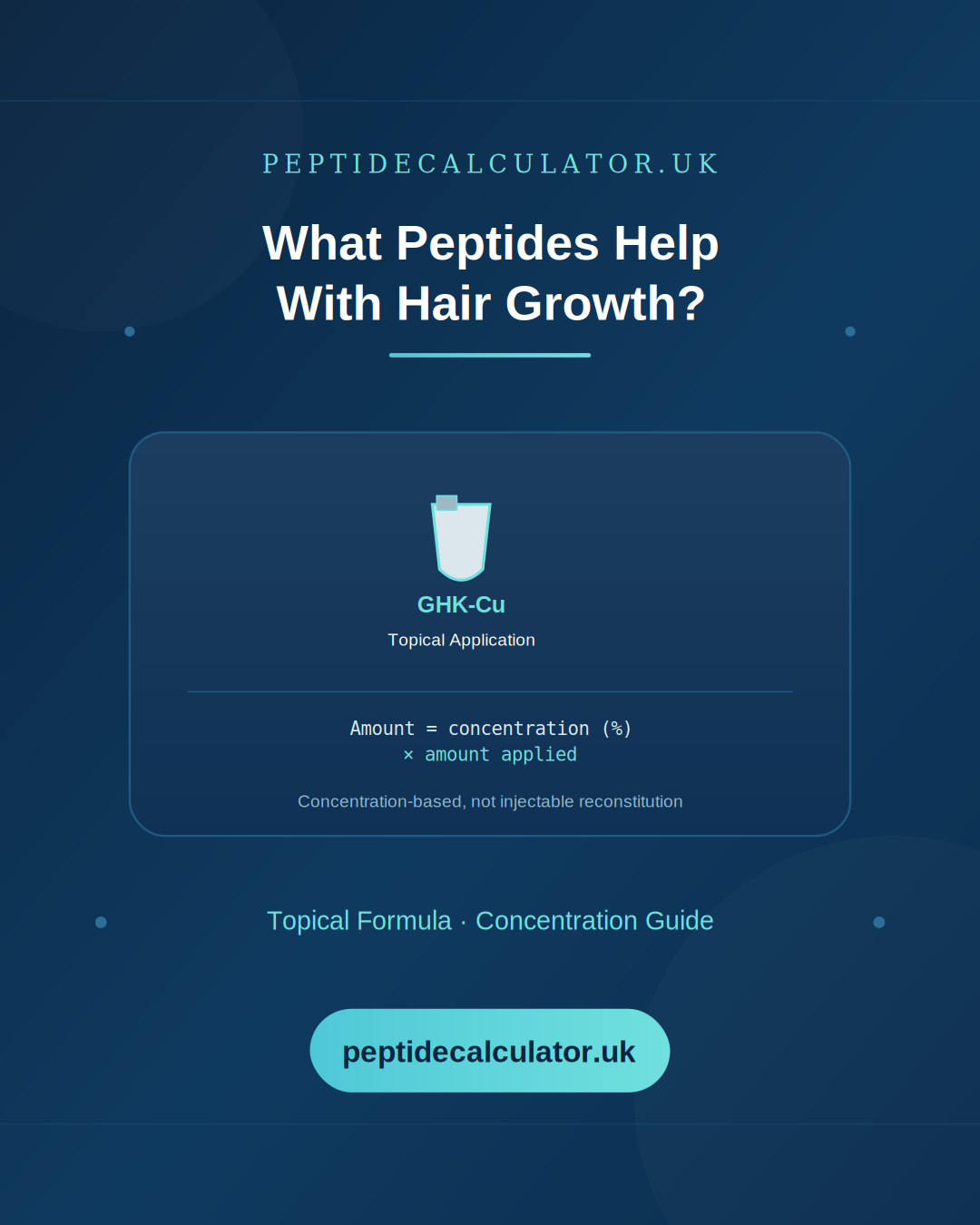
Our GHK-Cu dosing guide covers both formats in detail, but for hair-growth purposes specifically, the relevant calculation isn't the injectable reconstitution formula — it's a concentration-based calculation for topical application:
Amount of GHK-Cu per application = Product concentration (%) × Amount appliedThis is fundamentally different math from the mg-to-mcg-to-syringe-units calculation used for injectable peptides, and conflating the two is a common source of confusion when researching this specific use case.
Why Copper Peptides Are Discussed in This Context
GHK-Cu's connection to hair-growth discussions generally centers on its proposed role in supporting healthy tissue and cellular processes at the topical application site. This is a different mechanism entirely from GLP-1 receptor agonists or growth hormone secretagogues discussed elsewhere on this site — it's specific to GHK-Cu's particular properties as a copper-binding peptide, not a general "peptide" effect.
Product Concentration Varies Significantly
Topical GHK-Cu products on the market vary widely in stated concentration, commonly somewhere in a 1-5% range depending on the specific product and manufacturer. There's no single standardized concentration across the category, which is why checking your specific product's label is more useful than assuming a general figure applies. Our GHK-Cu guide includes a worked example of the topical concentration formula.
Is There an Injectable Version for Hair Growth?
Injectable GHK-Cu exists and follows the standard peptide reconstitution formula, but hair-growth discussion in particular is much more commonly associated with the topical format specifically. If you're seeing injectable GHK-Cu discussed for this purpose, it's worth double-checking the specific context and source, since this differs from the more commonly referenced topical application method for this use case.
Common Misconceptions
- Assuming GHK-Cu's hair-growth use follows the same injectable reconstitution formula as other peptides. For this specific use case, it's almost always the topical, concentration-based calculation instead.
- Assuming all copper peptide products use the same concentration. Always check your specific product's label rather than assuming a standard figure.
- Assuming this is a broadly "peptide" effect rather than something specific to GHK-Cu's particular properties. Other peptides discussed elsewhere on this site (semaglutide, BPC-157, etc.) have no established connection to hair growth specifically.
Frequently Asked Questions
Is GHK-Cu the only peptide associated with hair growth? It's by far the most commonly discussed one in this specific context. Other peptides may come up in broader skin or wellness discussions, but GHK-Cu is the primary compound specifically associated with hair-growth applications.
Should I use a topical or injectable GHK-Cu product for hair growth? This context is overwhelmingly associated with topical application specifically. If you're considering an injectable approach for any reason, that's a more significant decision worth discussing with a healthcare provider or dermatologist directly.
How do I calculate how much GHK-Cu I'm applying? Use the concentration-based formula (product % × amount applied) rather than the injectable reconstitution formula. See our GHK-Cu guide for a full worked example.
Are there other ingredients typically paired with GHK-Cu in hair products? Commercial topical products often combine GHK-Cu with other ingredients as part of a broader formula. Always check the specific product's full ingredient list and concentration rather than assuming GHK-Cu is the sole active component.
Final Thoughts
Hair growth is a narrower peptide topic than it might first appear, centering almost entirely on GHK-Cu specifically, and predominantly in its topical rather than injectable form. Understanding this distinction — and using the correct concentration-based calculation rather than the injectable reconstitution formula — is the key practical difference when researching this particular use case compared to most other peptide topics on this site.
This article is for general education only. It is not medical advice. Consult a licensed healthcare provider or dermatologist before starting any hair treatment regimen.