Peptide Blog Article
Sterile Water vs Bacteriostatic Water: Which Should You Use?
Choosing the right diluent is an important part of peptide reconstitution, and understanding the difference between sterile water and bacteriostatic water can help you follow proper storage and handling practices. Although both are used to reconstitute lyophilized peptides, they are not interchangeable in every situation. This educational guide explains the key differences between sterile water and bacteriostatic water, including their preservatives, common use cases, and why bacteriostatic water is typically preferred for multi-dose vials. It also covers how the choice of diluent affects storage and stability while explaining why the underlying reconstitution calculations remain the same regardless of which diluent is used. You'll also learn about common mistakes, frequently asked questions, and best practices for selecting the appropriate diluent based on manufacturer instructions. For accurate reconstitution calculations, dosage conversions, and syringe unit estimates, you can use the free tools available at PeptideCalculator.uk. This article is provided for educational purposes only and should not be considered medical advice. Always follow your product manufacturer's instructions and consult a qualified healthcare professional when appropriate.
Sterile Water vs Bacteriostatic Water: Which Should You Use?
Both sterile water and bacteriostatic water are used to reconstitute lyophilized peptides, but they aren't interchangeable — the difference between them matters most when it comes to how many times a vial can safely be accessed after mixing. This guide breaks down what separates the two and how to decide which one fits your situation.
This article is for general education only. It is not medical advice. Always follow the specific instructions provided by your product's manufacturer.
The Core Difference
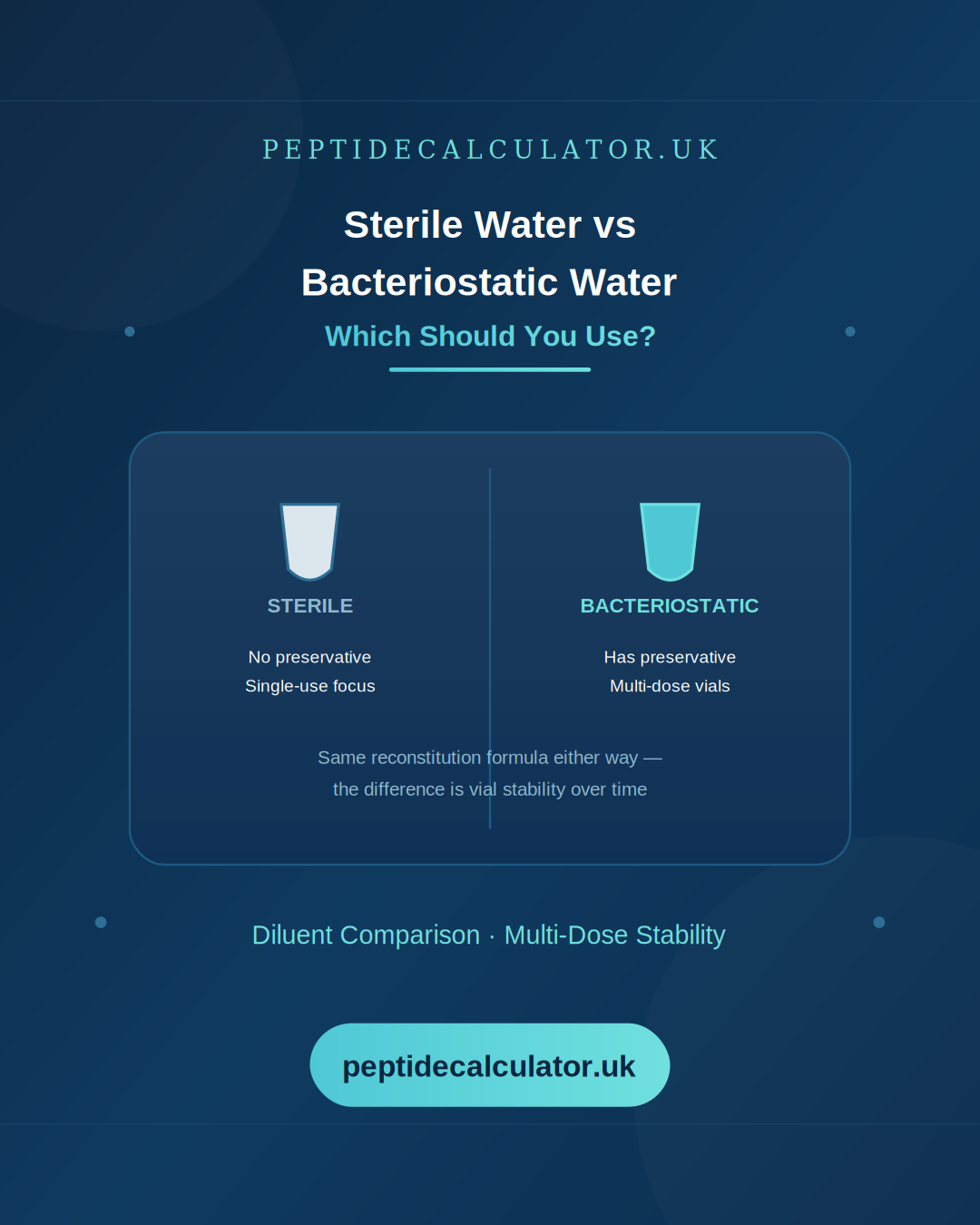
- Sterile water is purified water with no added preservative. It's sterile at the point of packaging, but once a vial is opened or accessed, there's nothing in the solution to inhibit bacterial growth over time.
- Bacteriostatic water is sterile water with a small amount of added preservative (commonly benzyl alcohol), which inhibits bacterial growth across multiple accesses. This is why it's the standard choice for multi-dose vials that will be drawn from repeatedly over days or weeks.
Why This Matters for Peptide Reconstitution
Most peptide protocols involve reconstituting a vial once and then drawing multiple individual doses from it over time — sometimes over several weeks. This repeated access is exactly the scenario bacteriostatic water is designed for for, since its preservative helps maintain sterility across those multiple draws. Sterile water, lacking that preservative, is generally considered appropriate for single-use situations rather than a vial that will be accessed repeatedly.
When Each Is Typically Used
| Sterile Water | Bacteriostatic Water | |
|---|---|---|
| Preservative | None | Yes (commonly benzyl alcohol) |
| Typical use case | Single-dose, immediate use | Multi-dose vials, repeated access |
| Multi-dose stability | Not generally intended for this | Designed for this |
| Common pairing | One-time reconstitution and injection | Standard peptide reconstitution protocols |
Why Most Peptide Protocols Use Bacteriostatic Water
Since the majority of peptide dosing involves drawing several doses from the same reconstituted vial over an extended period, bacteriostatic water is the more commonly recommended diluent across peptide reconstitution guides generally, including our own full reconstitution guide. The preservative content is specifically what makes repeated access safer over the vial's stability window.
When Sterile Water Might Be Used Instead
Sterile water is sometimes specified for situations where a vial will be used once and not stored for repeated future access, or in specific cases where a manufacturer's instructions call for it directly — for instance, some product-specific formulations or sensitivities to the preservative in bacteriostatic water. If your specific product's documentation calls for sterile water, that guidance takes priority over general defaults, since manufacturers test their own formulations against particular diluents.
Does the Diluent Choice Affect Reconstitution Math?
No — the reconstitution and syringe-draw formulas are the same regardless of which diluent you use:
Concentration (mg/mL) = Total peptide in vial (mg) ÷ Diluent added (mL)
Units to draw = (Target dose in mcg ÷ (Vial mg × 1000)) × Diluent added (mL) × 100
A peptide calculator doesn't need to know which diluent you're using — it just needs the volume added, since that's what determines concentration. What changes based on diluent choice isn't the math, it's the vial's expected stability window afterward.
Common Mistakes
- Assuming the two diluents are interchangeable for multi-dose use. Sterile water lacks the preservative that supports repeated access over time.
- Not checking product-specific instructions, and defaulting to a general assumption instead of what the manufacturer actually specifies.
- Assuming diluent choice affects the reconstitution formula. It doesn't — only the stability timeline differs.
- Reusing sterile-water-reconstituted vials repeatedly over weeks, which runs counter to what sterile water without a preservative is generally intended for.
Frequently Asked Questions
Can I use sterile water if that's what I have on hand? If your product's specific instructions call for bacteriostatic water, it's best to use what's specified rather than substituting based on availability, since the two aren't equivalent for multi-dose stability purposes.
Does bacteriostatic water's preservative affect the peptide itself? The preservative is specifically included to inhibit bacterial growth in the solution, not to interact with the peptide directly — but always defer to your specific product's documentation, since formulation-specific guidance takes priority over general information.
Is one diluent more expensive than the other? Pricing varies by supplier, but this typically isn't the deciding factor — the practical difference in multi-dose stability is what should guide the choice for most peptide reconstitution scenarios.
Can I switch from bacteriostatic to sterile water partway through a vial's use? This isn't standard practice, since the vial's stability assumptions were established at the time of initial reconstitution. It's best to use one diluent consistently for a given vial rather than mixing approaches.
Final Thoughts
For most peptide reconstitution scenarios involving multiple doses drawn over time, bacteriostatic water's preservative content makes it the standard choice over sterile water. The reconstitution math itself doesn't change based on which diluent you use — a peptide calculator only needs your diluent volume, not its type — but the stability window afterward depends heavily on this choice, so always follow your specific product's instructions.
This article is for general education only. It is not medical advice. Always follow the specific instructions provided by your product's manufacturer.